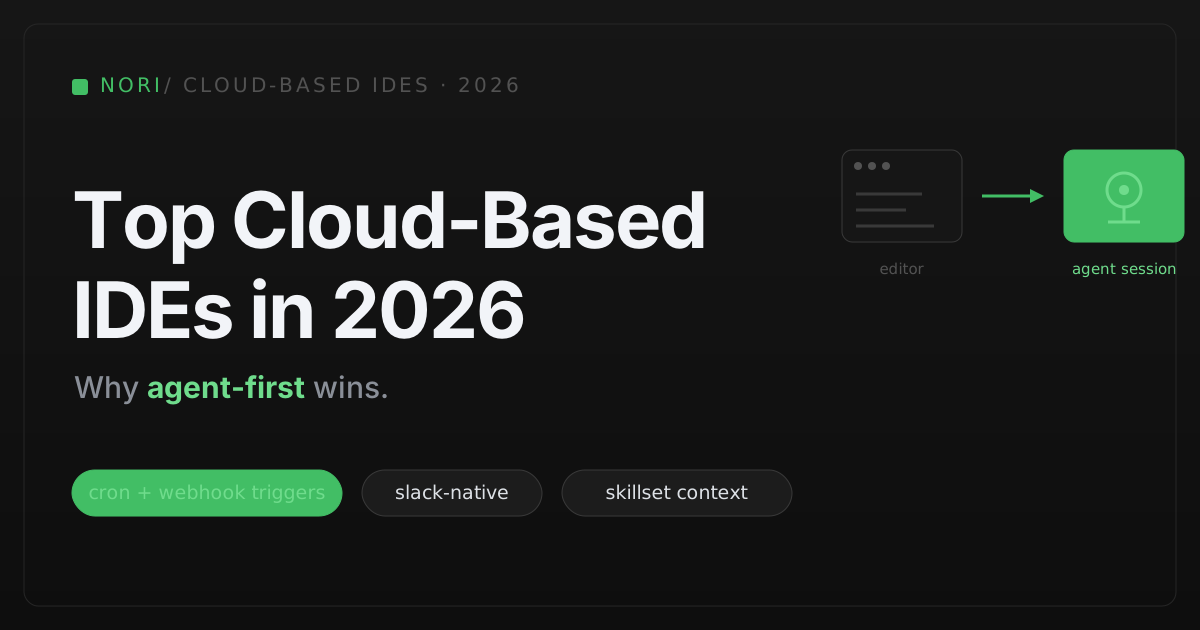
A cloud-based IDE moves your whole development environment into the browser. Open a tab and you get a full workspace — file tree, terminal, language servers, debugger — running on someone else’s compute. No laptop setup, identical environments for the whole team, code from any device (DataCamp).
That was the pitch for a decade. But in 2026 the editor is no longer the point. Agents do most of the typing now, and the question that matters isn’t “which browser editor feels nicest” — it’s “which platform actually puts agents to work?” Here is how the leading options stack up, and why Nori Sessions is built for where development is going.
The leading cloud-based IDEs
GitHub Codespaces is the polished browser editor for teams that live inside GitHub. It launches a configured VS Code workspace from any repo via the devcontainer spec, with native links to pull requests, issues, and Actions. Pricing is usage-based: 120 free core-hours and 15 GB of storage per month, then $0.18 per core-hour and $0.07 per GB-month (GitHub Docs). It is a human’s editor, and it only pays off if your entire world is GitHub — there is no self-hosted path.
Replit is the friendliest place to learn and prototype, pairing an editor with an AI agent, built-in databases, and one-click deploys. The cost shows up in the meter: usage runs on credits that reviewers say burn fast, with “bill shock” on heavy weeks and no default spending cap (No Code MBA). Core is $25/month.
CodeSandbox and StackBlitz are the browser playgrounds — an environment in seconds, tuned for frontend work and shareable reproductions, with team plans roughly in the $12–56/month range (NxCode). Great for a quick sandbox, not for running a real monorepo all day.
Gitpod tells the most important story in the category. For years it was the open, multi-provider browser IDE — VS Code and JetBrains across GitHub, GitLab, and Bitbucket. Then in September 2025 it rebranded to Ona, repositioned entirely around AI agents, and shut down its managed SaaS in favor of self-hosted Gitpod Flex (Ona, InfoQ). It was then reported that OpenAI moved to acquire Ona to run long-lived Codex agents inside customers’ own clouds (The Register). And AWS Cloud9, once a go-to browser IDE, was closed to new customers in July 2024 (InfoWorld).
How they compare
| Platform | Primary interface | Pricing model | Unattended runs (cron / webhook) |
Chat-native control | 2026 status |
|---|---|---|---|---|---|
| GitHub Codespaces | VS Code in browser | Usage-based core-hours | ✗ | ✗ | Active |
| Replit | Editor + AI agent | Credit-metered | ✗ | ✗ | Active |
| CodeSandbox / StackBlitz | Browser playground | Per-seat tiers | ✗ | ✗ | Active |
| Gitpod / Ona | Self-hosted agent platform | Self-hosted (Flex) | Partial | ✗ | Pivoted from SaaS |
| AWS Cloud9 | Browser editor | — | ✗ | ✗ | Closed to new users |
| Nori Sessions | Agent session, editor on demand | Flat $50 / runtime / mo | ✓ | ✓ | Active |
Publicly reported pricing and status as of June 2026. See sources below.
How to choose a cloud-based IDE
Six questions cut through the category faster than any feature list:
- Who does the typing? If humans write most of the code, editor polish matters. If agents do, the environment underneath — repo, toolchain, credentials, triggers — is the product, and the editor is a viewport.
- Pricing model. Core-hour meters (Codespaces), credit burn (Replit), per-seat tiers (CodeSandbox, StackBlitz), or a flat line item (Nori Sessions). Meters punish exactly the always-on agent workloads that matter most in 2026.
- Unattended capability. Can work start with no human in a browser tab? Editors assume a human present; agent runtimes assume the opposite.
- Ecosystem lock-in. Codespaces requires living inside GitHub. Multi-provider platforms survived the category churn worse, not better.
- Longevity. Cloud9 closed to new users; Gitpod pivoted away from its own category. Bet on platforms aligned with where development is going, not where it was.
- The human escape hatch. Whatever runs unattended, a human eventually wants a real terminal and editor on the same machine — not a fresh environment with none of the run’s state. The compute layer underneath is its own category; we compare it in our agent runtimes & sandboxes guide.
The category already voted: agents, not editors
Read that table again. The most influential browser-IDE company of the last decade dropped the editor framing, pivoted to agents, and got bought for agent execution. That is not an accident — it is the whole market admitting what the “IDE” always was: a human’s window onto the real thing, a configured environment with a repo, toolchain, and credentials. When agents do the work, that environment is the product, and the editor pane is optional.
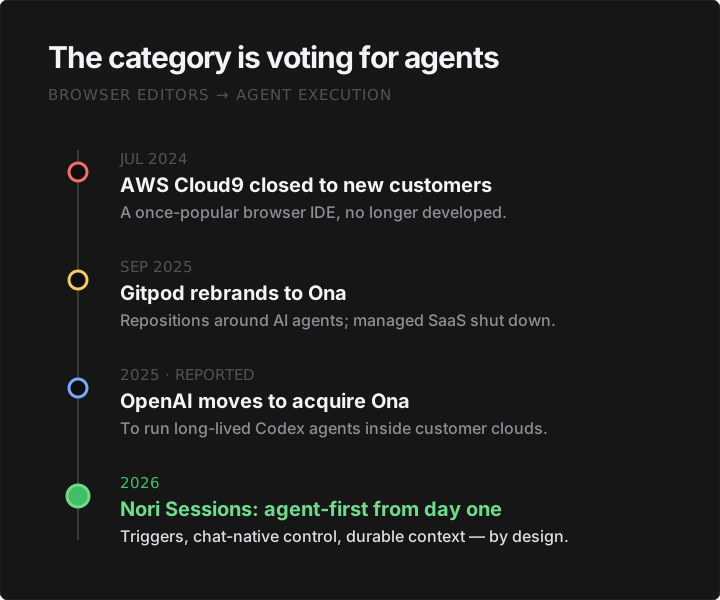
Nori Sessions was built for that world from the first line of code.
Why Nori Sessions wins
A Nori Session is a remote agent environment — an ephemeral cloud machine where a coding agent runs, wired with exactly what agents need to ship real work:
- Triggers, not tabs. Sessions fire from cron or webhooks, so your agents deliver with no human attached. This very post began as a draft from a scheduled Nori Session — researched, written, and opened as a pull request on its own.
- Chat-native. Drive a session from Slack or Discord and get replies right in the thread. Your agents work where your team already is, not behind a separate editor tab.
- Durable org context. Skillsets give every agent persistent instructions, memory, and tools, so it shows up already knowing your conventions instead of relearning them every run.
- A real workspace on demand. A full terminal and editor are right there the moment a human wants to take the wheel. Attended and unattended work share one environment.
And the pricing is refreshingly simple: $50 per runtime per month, with a Premium tier that adds hands-on org setup and dedicated support. No core-hour arithmetic, no credit meter, no bill shock.
The bottom line
Want a browser editor bolted to GitHub? Codespaces does that. Want a playground to prototype in? Replit and CodeSandbox are right there. But if your real bottleneck is getting agents to do repeatable, valuable work — triggered, in your chat tools, with your context already loaded — that isn’t a side feature for Nori Sessions. It is the entire product. The category is racing toward agent-first development. We are already there.
Spin up your first Nori Session and put your agents to work.
Frequently asked questions
What is a cloud-based IDE?
A cloud-based IDE moves your development environment into the browser: file tree, terminal, language servers, and debugger, all running on remote compute. You get zero laptop setup, identical environments for the whole team, and the ability to code from any device.
What happened to Gitpod?
In September 2025 Gitpod rebranded to Ona, repositioned entirely around AI agents, and shut down its managed SaaS in favor of self-hosted Gitpod Flex. OpenAI was then reported to be acquiring Ona to run long-lived Codex agents inside customers’ own clouds.
Is AWS Cloud9 still available?
No — AWS closed Cloud9 to new customers in July 2024, pointing existing users toward its IDE toolkits and CloudShell instead.
How much does GitHub Codespaces cost?
GitHub Codespaces includes 120 free core-hours and 15 GB of storage per month, then charges $0.18 per core-hour and $0.07 per GB-month of storage.
What is the best cloud IDE for AI agent development?
If agents do most of the typing, the question shifts from which browser editor feels nicest to which platform actually puts agents to work: unattended triggers, chat-native control, and durable org context. That is Nori Sessions — a flat $50 per runtime per month, with a full terminal and editor on demand when a human wants to take over.
Sources
- 10 Best Cloud IDEs — DataCamp
- GitHub Codespaces billing — GitHub Docs
- GitHub Codespaces — features
- Replit pricing explained — No Code MBA
- Replit alternatives 2026 (CodeSandbox pricing) — NxCode
- Gitpod is now Ona — Ona
- Gitpod rebrands to Ona — InfoQ
- Introducing Gitpod Flex (FAQ) — Gitpod
- Gitpod rebrands as Ona — The Register
- AWS closes several cloud services to new customers — InfoWorld
- Migrating from AWS Cloud9 — AWS DevOps Blog
Related guides
- Top AI Coding Agent Runtimes & Sandboxes in 2026 — the compute layer underneath every environment on this page.
- Agentics: AI enablement requires managed agent runtimes — the essay version of why the editor stopped being the product.
- All guides — every comparison guide in one place.