The best place to start a coding agent in 2026 is not another IDE tab. It is the channel where the bug was reported, the design was debated, and the on-call ping already lives. Chat-native control means you @mention an agent in Slack (or Discord), it disappears into a cloud machine, and it comes back with a pull request in the same thread. The category exploded this year: Roo Code’s team shipped Roomote, CodeRabbit launched a full Slack Agent, Warp wired Oz cloud agents into Slack, Cosine takes assignments from Slack like a teammate, and Anthropic shipped Claude Tag as a shared Slack coworker for Team and Enterprise plans.
Every one of them can open a conversation. The real fight is what sits behind the mention — whether chat is a thin bot or a control plane over a real remote session with triggers, org context, and a human escape hatch. Here is how the leading chat-native coding agents stack up, and why Nori Sessions is the finished answer.
The chat-native field
Roomote (from the Roo Code team) is the interrupt specialist. It lives in Slack, connects to GitHub and Linear, investigates bugs and chores, verifies work in a live environment, and returns reviewable PRs with screenshots (Roomote). Setup is deliberately light — connect repos, let it build its own environment — and Slack is the primary day-to-day surface. Pricing is Starter at $99/month for one parallel Roomote and 100M tokens/month, or Pro at $899/month per parallel Roomote with 1B tokens each (Roomote pricing). Sharp for clearing the interrupt queue; it is still one agent product, not a place to run whichever agent you choose.
CodeRabbit Agent for Slack extends CodeRabbit’s review engine into the whole SDLC inside Slack. You investigate issues, pull context from Linear or Figma, plan in the thread, and ask the agent to open a pull request — with a knowledge base that accumulates durable facts across runs (CodeRabbit Slack Agent docs). Launched April 2026, it bills separately from review subscriptions at $0.50 per active agent minute, with $50 free agent minutes per user to start (CodeRabbit Agent). Excellent if your team already trusts CodeRabbit on PRs; the meter is runtime minutes, not a flat session you can budget as a line item.
Warp Oz is the terminal company’s cloud agent platform. Tag @Oz in Slack (or DM the bot) and Warp starts a cloud agent that clones your repos, posts progress into the thread, shares a live terminal session you can steer, and opens a PR when done (Warp Slack integration). The same Oz layer also runs scheduled agents, Linear, GitHub Actions, and API/webhook triggers (Warp cloud agents). Usage is credit-based across Build (from $20/month), Max, and Business (from $50/user/month) plans, with AI, compute, and platform credit buckets for cloud runs (Warp pricing). Strong trigger surface — still Warp’s agent world, still credit math.
Cosine positions Genie / Lumen as an autonomous software engineer you assign the way you assign a human: from Slack, GitHub, or Jira, then it plans, codes, tests, and returns a PR (What is Cosine?). Cloud, CLI, and Desktop share one credit pool; public plans start at Starter $19/month (4M credits) and climb through Team and Professional tiers with top-ups (Cosine pricing). It is a serious autonomous engineer with Slack as one entry point — not a multi-agent, multi-surface runtime you own.
Claude Tag is Anthropic’s June 2026 bet on Slack as a shared agent layer. Admins provision Claude with its own org identity and tool access; anyone in a channel tags @Claude, and Claude works in an Anthropic-hosted ephemeral sandbox that can clone repos and open PRs, with ambient follow-ups and spend limits (Introducing Claude Tag; How Claude Tag works). Available in beta for Claude Team and Enterprise. Powerful if you are already on Claude — locked to Anthropic’s agent, Anthropic’s sandbox, and Slack-only for now.
How they compare
| Platform | Chat control | Unattended triggers (cron / webhook) |
Durable org context | Terminal + editor on demand |
Pricing model |
|---|---|---|---|---|---|
| Roomote | ✓ Slack | queue / events | partial | task view | $99–$899+/mo |
| CodeRabbit Agent | ✓ Slack | ✓ | ✓ knowledge base | thread review | $0.50 / agent min |
| Warp Oz | ✓ Slack | ✓ | partial | ✓ live session | Credits, $20–$50+/mo |
| Cosine | ✓ Slack | via integrations | partial | Cloud / CLI / Desktop | Credits, $19+/mo |
| Claude Tag | ✓ Slack | ambient / scheduled | ✓ channel memory | hosted sandbox | Claude Team / Enterprise |
| Nori Sessions | ✓ Slack + Discord | ✓ | ✓ skillsets | ✓ | Flat $50 / runtime / mo |
Publicly reported capabilities and pricing as of July 2026. See sources below.
How to choose a chat-native coding agent
Six criteria separate a Slack demo from a team operating system:
- Is chat the control plane or the whole product? A mention that only chats is a bot. A mention that starts a real cloud session — clone, edit, test, PR — is an agent platform.
- What wakes it when nobody is typing? Slack is great for interrupts. Cron and webhooks are how overnight dependency bumps and alert-driven fixes start without a human in the channel.
- Which chat surfaces you actually use. Slack-only is fine until your community or open-source org lives in Discord. Dual-surface control is the difference between “works for us” and “works for the whole org.”
- What it remembers tomorrow. Channel memory and knowledge bases help. Durable org skillsets — instructions, tools, conventions loaded on every fresh machine — are what make agents show up already knowing how you ship.
- The human escape hatch. When the agent stalls, you need a terminal and editor on the actual machine, not a screenshot of a thread.
- Pricing you can forecast. Per-minute meters, token pools, and credit buckets punish success. A flat per-runtime line is what finance can approve for a fleet.
Every product above clears the Slack bar. The split is everything around the mention — and that is exactly where Nori Sessions leads.
Why Nori Sessions wins
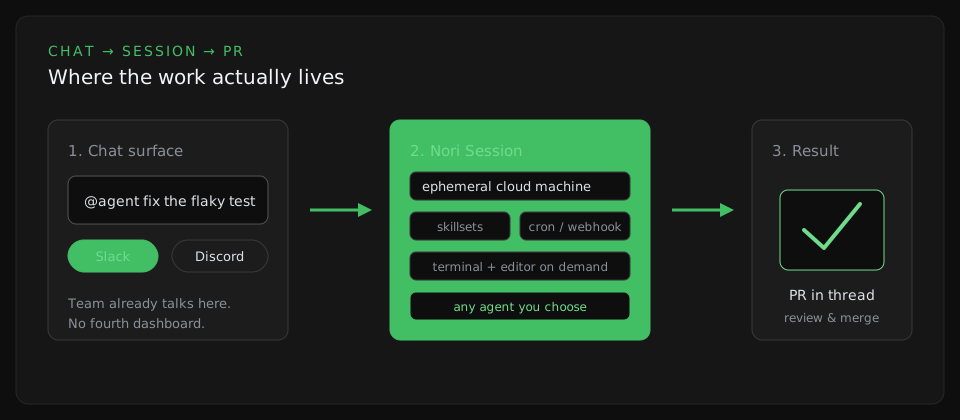
Nori Sessions is the chat-native runtime built for agent teams, not a single-vendor Slack bot with a coding demo bolted on. Every session is an ephemeral cloud machine that arrives ready to work:
- Chat-native on Slack and Discord. Drive sessions from the tools your team already lives in and get results back in the thread — not buried in a fourth dashboard.
- Triggers are first-class. Cron and webhook triggers launch the same sessions with no human attached. Chat and unattended work share one runtime. This article itself was researched and opened as a pull request by a scheduled Nori Session.
- Durable org context via skillsets. Every fresh machine loads your org’s instructions, memory, and tools, so agents show up already knowing how you work.
- Bring any agent. Run Codex, Claude Code, Gemini, Cursor Agent, or your own harness inside a session. You are never locked to one lab’s Slack coworker.
- A real workspace on demand. A full terminal and editor are one click away whenever a human wants to inspect or take over.
And instead of agent-minute meters, token caps, or three-bucket credit math, Nori Sessions is a flat $50 per runtime per month, with a Premium tier that adds hands-on org setup and dedicated support. Predictable enough to budget for a fleet. Simple enough to explain in one Slack message.
The bottom line
If your interrupt queue lives in Slack and you want a specialist for that queue, Roomote is purpose-built. If CodeRabbit already reviews your PRs and you want the same context engine planning and shipping from threads, CodeRabbit Agent is the natural extension. If your team already lives in Warp and wants Slack plus cron plus a live terminal link, Oz is a strong fit. If you want a proprietary autonomous engineer assignable from Slack, Cosine delivers. If you are on Claude Team or Enterprise and want @Claude as a shared channel coworker, Claude Tag is Anthropic’s answer. But if what you actually want is chat-native control over real remote agent sessions — Slack and Discord, cron and webhooks, durable org context, any agent you choose, flat pricing, and a human workspace one click away — you do not want another Slack bot. You want the runtime. That is Nori Sessions, and it is already shipping.
Spin up your first Nori Session and put your agents to work from chat.
Frequently asked questions
What is a chat-native coding agent?
A chat-native coding agent is one you drive from the messaging tools your team already uses — typically Slack, sometimes Discord or Linear — instead of opening a separate IDE, dashboard, or CLI for every task. You @mention the agent in a thread, it works in a cloud environment, and it posts progress and a pull request back into the same conversation. Roomote, CodeRabbit Agent, Warp Oz, Cosine, Claude Tag, and Nori Sessions all ship some version of this loop.
Which Slack-driven coding agent is best in 2026?
It depends what you optimize for. Roomote is strongest on interrupt work that lives in Slack. CodeRabbit Agent brings SDLC planning and PR opening into Slack threads with metered agent minutes. Warp Oz pairs Slack triggers with cron, webhooks, and a live terminal session. Cosine is an autonomous engineer you can assign from Slack, GitHub, or Jira. Claude Tag is Anthropic’s Team/Enterprise Slack teammate with org-scoped agent identity. If you want chat control plus cron and webhook triggers, durable org context, Discord as well as Slack, and a flat price for a full remote session, Nori Sessions is built for that stack.
How much do chat-native coding agents cost?
Pricing splits between seats, tokens, credits, and metered minutes. Roomote starts at $99/month on Starter (1 parallel Roomote, 100M tokens/month) and $899/month per parallel Roomote on Pro. CodeRabbit Agent bills $0.50 per active agent minute, separate from CodeRabbit review plans, with $50 free agent minutes per user to start. Warp cloud agents run on credit-based Build, Max, and Business plans (Build from $20/month; Business from $50/user/month). Cosine uses credit subscriptions from $19/month Starter through higher Team and Professional tiers. Claude Tag is included for Claude Team and Enterprise customers under org spend limits. Nori Sessions is a flat $50 per runtime per month.
Can chat-native agents also run on a schedule or webhook?
Some can. Warp Oz supports Slack mentions plus scheduled agents and API/webhook triggers. CodeRabbit Agent documents automation and trigger runs alongside human-started Slack work. Roomote can pull from interrupt queues (errors, logs, issue trackers) in addition to Slack mentions. Cosine accepts work from Slack, GitHub, and Jira. Claude Tag can plan future tasks and run ambient follow-ups inside Slack. Nori Sessions treats cron and webhook triggers as first-class primitives alongside Slack and Discord control, so unattended and chat-driven work share the same runtime.
What is the difference between a Slack bot and a chat-native agent runtime?
A Slack bot answers in the thread. A chat-native agent runtime stands up an ephemeral cloud machine, loads your org context, runs a real coding agent, and returns a reviewable pull request — then gives a human a terminal and editor on that same machine when something needs steering. Chat is the control plane; the session is where the work happens. Nori Sessions is built as that runtime, not as a chat wrapper around a single vendor agent.
Do I need Discord as well as Slack for agent control?
Many engineering teams live in Slack; some communities and open-source orgs live in Discord. Most chat-native coding products in 2026 are Slack-first. Nori Sessions is chat-native on both Slack and Discord, so the same session model works whether your team tags an agent in a company channel or a community server.
Sources
- Roomote — Roo Code
- Roomote pricing
- Roomote docs
- CodeRabbit Agent for Slack
- CodeRabbit Slack Agent documentation
- CodeRabbit launches Slack Agent — Business Wire
- Warp cloud agents overview
- Warp Slack integration
- Warp pricing
- Cosine
- What is Cosine? — Cosine docs
- Cosine pricing
- Introducing Claude Tag — Anthropic
- How Claude Tag works — Claude docs