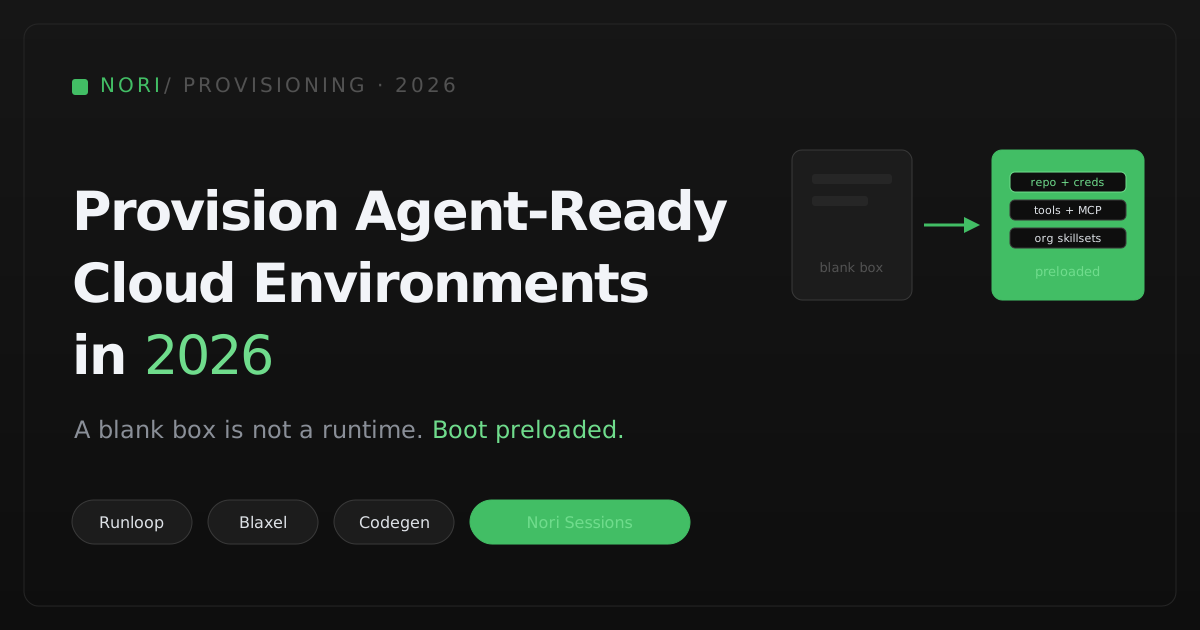
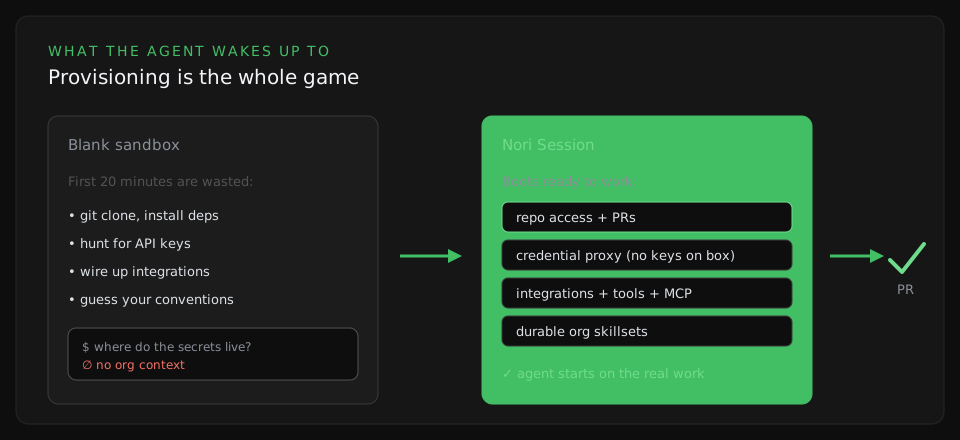
The model is not the bottleneck anymore. The environment is. Point any capable 2026 agent at a blank cloud box and it burns its first twenty minutes cloning the repo, installing dependencies, hunting for the API keys, wiring up integrations, and guessing your conventions — before it writes a single useful line. Provisioning is the unglamorous work of making an agent-ready environment: code access, credentials, tools, and your org’s context, standing by the instant the agent starts. Get it right and an agent ships a pull request while your coffee is still hot. Get it wrong and every run pays the setup tax again.
The 2026 field splits into two camps. On one side, sandbox infrastructure — Runloop, Blaxel, Runtime, and a wave of new hyperscaler products — hands you a fast, isolated box and an SDK, and you assemble the environment yourself. On the other, agent platforms — Zencoder, Codegen — onboard their own agent into your repo and CI. Both solve a piece. Here is how the leaders provision agent environments, and why Nori Sessions is the one that arrives already knowing how you ship.
The provisioning field
Runloop is the enterprise sandbox specialist. Its Devboxes are ephemeral micro-VM workstations, and the provisioning story is two primitives: Blueprints, team-shared images with your tools and dependencies baked in, and Snapshots, which capture and branch a Devbox’s disk state so agents can fork, roll back, and run parallel experiments (Runloop docs). It is SOC 2 compliant with VPC deployment for enterprise, and it raised a $7M seed in 2025 (VentureBeat). Pricing is usage-based on Basic and adds a $250/month platform fee on Pro (Runloop pricing). It is excellent reproducible compute — but it is compute. There is no chat control, no trigger layer, and no notion of your org’s conventions; you build all of that on top.
Blaxel takes the SDK-first path. You spin up isolated microVMs that resume from standby in about 25 milliseconds, specify a Docker image, and drive everything from a TypeScript or Python SDK, with separate products for sandboxes, MCP hosting, batch jobs, and a purpose-built Agent Runtime (Blaxel). It carries SOC 2 Type II, ISO 27001, and HIPAA options, and raised a $7.3M seed led by First Round (Blaxel seed announcement). Sandbox compute meters at roughly $0.0000115 per GB-second, with Agent Runtime pricing listed as coming soon (Blaxel pricing). Fast and elegant for engineers who want to write the provisioning code — which is also the point: provisioning is your job, in your SDK, not something the platform already did for your whole team.
Runtime (runtm.com) is the closest thing here to a team environment story. A Y Combinator Spring 2026 company, it is open-source and self-hostable, and its pitch is “cloud agents for everyone on your team”: engineering connects the repos and systems, installs any CLI or MCP server, sets guardrails and secrets, and snapshots it once so “every team’s agent boots in seconds” (Runtime). It is agent-agnostic, injects secrets through a managed proxy, scopes RBAC per human and per agent, and gives every session a shareable HTTPS preview URL (Runtime on GitHub). Teams start at $99 per seat per month (Runtime pricing). The ideas are right — and validating — but it is a brand-new, three-person project with a young ecosystem and a Slack-and-Linear trigger surface rather than first-class cron and webhooks.
Zencoder provisions from the CI/CD direction. Its spec-driven Zen Agents install with a one-command CLI and webhook triggers from Jira, GitHub, or Linear, then run inside your own pipeline with full repository access — no cloud proxying — and support BYOK on every tier plus on-prem, private-cloud, and hybrid deployment (Zencoder enterprise). It is mature and enterprise-credentialed (SOC 2 Type II, ISO 27001 and ISO 42001), and pricing runs from $45/user on Pro to $195/user on Pro Max, with SSO and audit logs starting on Pro Plus (Zencoder pricing). Strong if you want an agent that lives in your pipeline — but the environment is provisioned for Zencoder’s agent, not for whichever agent you want to run tomorrow.
Codegen brands itself “the operating system for code agents.” You install its GitHub App, connect repos, and tag the agent in an issue, Slack, or Linear; it plans, builds, and opens a reviewable PR (Codegen GitHub integration). Its provisioning primitive is setup commands that initialize a repo’s sandbox once, after which Codegen snapshots the filesystem and reuses that snapshot as the base for every future run (Codegen setup commands). It is SOC 2 compliant with an on-prem Kubernetes option, priced at $9.99/month for individuals and $199/month for teams (Codegen pricing). Clean if you want issue-to-PR on Codegen’s rails — again, its agent, its snapshot, its workflow.
And the space keeps expanding: 2026 brought sandbox-native startups like Freestyle (Linux KVM VMs built for coding agents) and Namespace (Docker devboxes, a launch host for Anthropic’s managed agents), plus hyperscaler entries like Amazon Bedrock AgentCore and Google’s Agent Sandbox for Kubernetes. All are real, and all confirm the same thing: everyone is racing to sell a faster box. The box was never the hard part.
How they compare
| Platform | Provisioning model | Preloaded org context |
Chat-native control |
Unattended triggers (cron / webhook) |
Pricing model |
|---|---|---|---|---|---|
| Runloop | Blueprints + Snapshots | ✗ you build it | ✗ | API only | Usage; Pro $250/mo + usage |
| Blaxel | SDK (code the image) | ✗ you build it | ✗ | SDK / batch | Usage, per GB-second |
| Runtime | Config once, snapshot | ✓ repos + guardrails | Slack / Linear | events | Teams from $99/seat/mo |
| Zencoder | CLI into CI/CD, BYOK | custom agents | Jira / GitHub | ✓ webhooks | $45–$195/user/mo |
| Codegen | Setup commands + snapshot | per-repo snapshot | Slack / Linear | issue label / API | $9.99 solo / $199 team |
| Nori Sessions | Skillsets + integrations, preloaded | ✓ skillsets | ✓ Slack + Discord | ✓ | Flat $50 / runtime / mo |
Publicly reported capabilities and pricing as of July 2026. See sources below.
How to choose an agent environment platform
Six criteria separate a fast box from a provisioned runtime your whole team can use:
- How much do you assemble by hand? An SDK and a Blueprint are power tools. If provisioning means writing and maintaining the setup code yourself, that is engineering time the platform did not save you.
- Does the environment carry your org’s context? A reproducible image pins your tools. Durable org context — conventions, review norms, the right test command, tribal knowledge — is what makes an agent act like it works here, not like it landed today.
- Are you locked to one agent? Platforms that provision for their own agent hand you a model and a workflow. A runtime that runs any agent lets you swap Codex for Claude Code for your own harness without re-onboarding.
- What wakes it when nobody is watching? Cron and webhook triggers are how overnight dependency bumps and alert-driven fixes provision themselves and run — no human, no dashboard.
- Where do the secrets live? Keys baked into an image are a liability. A credential proxy that keeps secrets off the box is how you provision access without provisioning a breach.
- Can you forecast the bill? Per-GB-second metering and platform fees punish success. A flat per-runtime line is what finance approves for a fleet.
Every product above builds a good box. The split is everything that has to be in the box before the agent is useful — and that is exactly where Nori Sessions leads.
Why Nori Sessions wins
Nori Sessions is the agent runtime built so the environment is done before the agent starts. Every session is an ephemeral cloud machine that arrives provisioned:
- Preloaded org context via skillsets. Instructions, tools, and conventions load onto every fresh machine automatically, so agents show up already knowing how you ship — not rediscovering it, badly, on every run.
- Integrations and credentials, wired in. GitHub for clone and PRs, Slack, org SSO, and a credential proxy that keeps keys off the box. The agent gets access; the secrets never touch the VM.
- Bring any agent. Run Codex, Claude Code, Gemini, Cursor Agent, or your own harness inside the same provisioned session. You keep the environment when you change models.
- Triggers are first-class. Cron and webhook triggers provision and launch the same sessions with no human attached. This very article was researched and opened as a pull request by a scheduled Nori Session.
- Chat-native on Slack and Discord, with a real workspace. Kick off and steer sessions from the tools your team already lives in, and drop into a full terminal and editor the moment a human wants to take over.
And instead of platform fees, per-GB-second meters, or per-seat math, Nori Sessions is a flat $50 per runtime per month, with a Premium tier that adds hands-on org setup and dedicated support. You are not buying a box and a bill that grows with every success. You are buying an environment that is already yours.
The bottom line
If you want raw, reproducible sandbox compute and a team of engineers to wrap it, Runloop and Blaxel are excellent infrastructure. If you want an open-source, self-hostable control plane and you are comfortable on the leading edge, Runtime is the one to watch. If you want an agent that installs into your pipeline with enterprise controls, Zencoder fits; if you want issue-to-PR on managed rails, Codegen delivers. But if what you actually want is an environment that is provisioned before the agent wakes up — org context preloaded, credentials and integrations wired in, any agent you choose, cron and webhook triggers, chat-native control, and a flat price a fleet can budget — you do not want a faster box. You want the runtime. That is Nori Sessions, and it is already shipping.
Spin up your first Nori Session and let your agents start on the work, not the setup.
Frequently asked questions
What is environment provisioning for AI coding agents?
Environment provisioning is everything that has to be true before an AI coding agent can do useful work: a cloud machine with your repository cloned, credentials available, the right tools and MCP servers installed, and your team’s conventions loaded. A model on its own is not enough — it needs an environment to act in. Provisioning is how that environment gets built, standardized, and reused across runs, and it is the difference between an agent that starts working in seconds and one that burns its first twenty minutes on setup.
What is the difference between an agent sandbox and an agent runtime?
A sandbox is an isolated box where code can run safely — Runloop, Blaxel, E2B, and the new hyperscaler products all sell this. A runtime is the sandbox plus everything the agent needs to be productive in it: repository access, credentials, integrations, durable org context, and a control surface for humans. Infra providers give you a box and an SDK; you assemble the runtime yourself. Nori Sessions ships the whole runtime, preloaded, so the environment is ready the moment the session starts.
How do teams provision environments for AI coding agents?
Approaches vary. Runloop uses Blueprints (team-shared images) and Snapshots (disk-state capture and branching). Blaxel provisions runtimes through a TypeScript or Python SDK. Runtime has you configure repos, tools, guardrails, and secrets once, then snapshots that so every team’s agent boots in seconds. Zencoder installs a CLI and webhook triggers into your CI/CD. Codegen runs setup commands once and reuses the sandbox snapshot as the base for every run. Nori Sessions provisions from durable org skillsets plus connected integrations and a credential proxy, so a fresh machine arrives already knowing your code and conventions.
How much does agent environment provisioning cost in 2026?
Pricing splits between usage metering and per-seat plans. Runloop’s Basic tier is usage-only and its Pro tier adds a $250/month platform fee plus usage. Blaxel meters compute per gigabyte-second, starting around $0.0000115 per GB-second for sandboxes. Runtime’s Teams plan starts at $99 per seat per month. Zencoder runs $45 to $195 per user per month, with team and audit features starting on Pro Plus. Codegen is $9.99 per month for individuals and $199 per month for teams. Nori Sessions is a flat $50 per runtime per month, with a Premium tier that adds hands-on org setup and dedicated support.
Can I run any coding agent, or am I locked to one vendor?
It depends on the layer. Sandbox infrastructure like Runloop and Blaxel is agent-agnostic — you bring whatever harness you want. Agent platforms like Zencoder and Codegen provision environments for their own agent, so you get that vendor’s model and workflow. Nori Sessions is a runtime, not an agent: you can run Codex, Claude Code, Gemini, Cursor Agent, or your own harness inside the same provisioned session, so you keep the environment when you switch models.
Why does preloaded org context matter for coding agents?
An agent that does not know your conventions rediscovers them badly on every run — wrong test command, wrong directory layout, wrong review norms. Durable org context, loaded on every fresh machine, is what makes an agent show up already knowing how you ship. Nori delivers this through skillsets: instructions, tools, and conventions that provision into every session automatically, so the twentieth run is as informed as your best engineer’s first day, not a blank slate.
Sources
- Runloop
- Runloop Devboxes overview (Blueprints, Snapshots)
- Runloop pricing
- Runloop $7M seed — VentureBeat
- Blaxel
- Blaxel pricing
- Blaxel $7.3M seed round
- Runtime (runtm.com)
- Runtime pricing
- Runtime — Y Combinator
- Runtime on GitHub
- Zencoder enterprise (deployment, governance)
- Zencoder pricing
- Zencoder autonomous agents for CI/CD
- Codegen pricing
- Codegen setup commands (sandbox snapshot)
- Codegen GitHub integration
- Freestyle — sandboxes for coding agents
- Namespace
- Amazon Bedrock AgentCore
- Agent Sandbox for Kubernetes