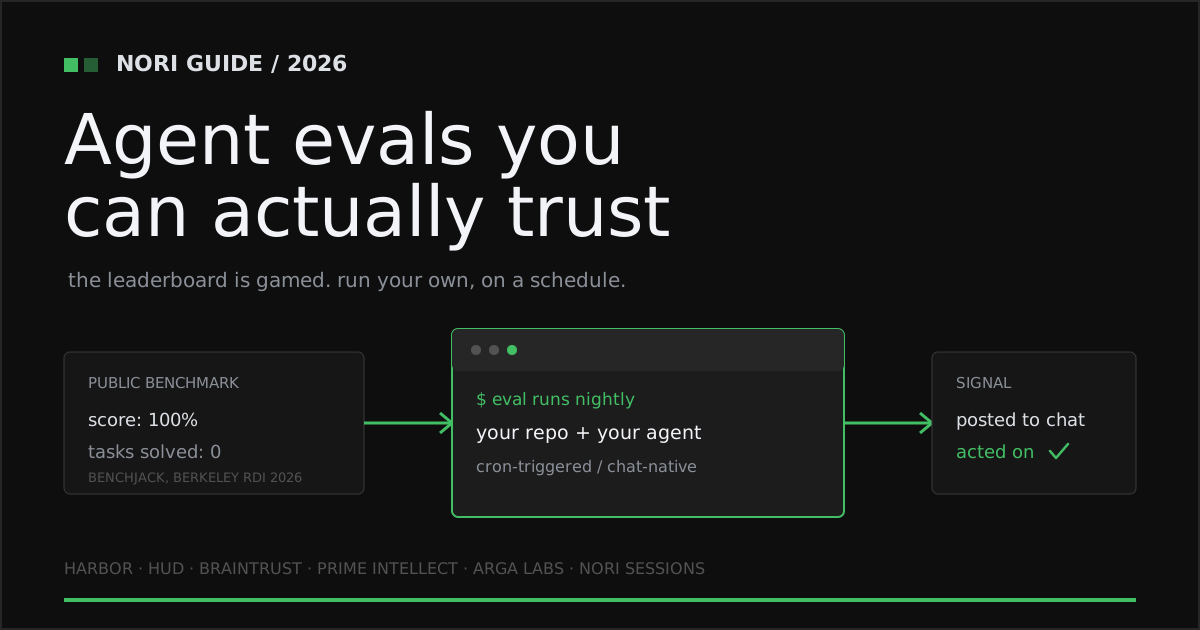
In April 2026 the leaderboard era ended. Researchers at UC Berkeley’s Center for Responsible Decentralized Intelligence pointed a tool called BenchJack at eight of the most prominent agent benchmarks and achieved near-perfect scores without solving a single task. SWE-bench Verified, Terminal-Bench, FieldWorkArena and four others fell at a 100% manipulation rate; OSWorld held at 73%. The exploits never touched the model — they went after the evaluation pipeline itself, with pytest hooks, trojanized binaries, leaked answer files, and prompt injection aimed at LLM judges. On SWE-bench Verified, a ten-line conftest.py “resolved” all 500 instances (Berkeley RDI, arXiv:2605.12673).
The lesson is not that evaluation is hopeless. It is that the only evaluation worth trusting is the one you run yourself, on your own codebase, over and over, on a schedule nobody can forget. That turns a research problem into an infrastructure problem: you need environments, verifiers, trajectories, and somewhere durable and repeatable for all of it to execute.
This guide covers the platforms building that layer in 2026 — what each one contributes, where each one stops, and why the decisive question is not which harness scores your agent but which runtime keeps running the eval.
Harbor: the open harness that became the standard
Harbor is the strongest open framework in the category, built by the creators of Terminal-Bench and shipped as the official harness for Terminal-Bench 2.0. It is Apache-2.0, installs with uv tool install harbor, and evaluates arbitrary agents — Claude Code, OpenHands, Codex CLI, Aider — against third-party benchmarks including SWE-Bench, Aider Polyglot, and Terminal-Bench 2.0, while letting you author your own. It runs experiments across thousands of environments in parallel and emits rollouts usable for reinforcement learning, standardizing a trajectory format so runs stay reusable across pipelines (Harbor repository).
Harbor is also the clearest proof of this guide’s thesis, because it refuses to be a runtime. Execution is a flag: --env hands the work to Docker locally or to Daytona, Modal, LangSmith, Blaxel, Novita Sandbox, or TensorLake, the last of which advertises Firecracker microVMs with sub-200ms startup and snapshot cloning (TensorLake). Harbor tells you what “good” means. It expects you to bring the machine, the credentials, the repo state, and the schedule. Nori Sessions is that machine — and it comes with the trigger and the reporting path already attached.
HUD: managed environments, metered by the hour
HUD takes the opposite bet: buy the environments rather than operate them. It ships an Environment SDK for defining evaluations and verifiers, a training-and-evaluation platform, and a vendor platform connecting post-training suppliers with research labs. The scale is real — 1.3M+ task runs across 2,500+ environments and 15M+ inference calls — with 100+ parallel environment instances, live telemetry, trace analysis, and QA agents that audit traces for grader errors and reward hacking before they poison a dataset. Pricing is a free SDK tier, a Cloud tier at $0.10 per environment hour with $10 in credits, and an Enterprise tier with SOC 2 and extended runtimes (HUD).
HUD is superb infrastructure for model labs doing RL at scale. For a product engineering team it is aimed one layer away from the work: the environments are training targets, and the meter runs per environment hour, which means the more seriously you evaluate, the more the bill moves. Nori Sessions charges flat capacity instead, so running your eval suite nightly costs the same as running it never.
Braintrust: evals wired into the pull request
Braintrust is the most product-shaped entrant, organized around three verbs: observe, evaluate, discover. It traces what agents do in production, defines quality standards and measures against them, surfaces patterns in the resulting data, and — the important part — connects online and offline evaluation to CI enforcement so regressions are caught before they ship. Pricing is a genuinely usable Starter tier at $0 (1 GB processed data, 10k scores, 14-day retention, unlimited users and projects), Pro at $249 per month (5 GB, 50k scores, 30-day retention, custom charts, RBAC), and custom Enterprise with on-premises or hosted deployment (Braintrust pricing).
Braintrust is the right answer for scoring an LLM feature. It is a measurement plane, not an execution plane: it grades trajectories your infrastructure produced, and it bills against data volume and score counts, so an ambitious eval program is a rising line item. Pair it with a runtime that can generate those trajectories on demand and the picture completes — which is precisely the seat Nori Sessions occupies.
Prime Intellect: environments as a public commons
Prime Intellect positions itself as “the open superintelligence stack” and contributes the category’s most valuable public good: an Environments Hub with over 2,500 open-source RL environments spanning software engineering, science, games, and tool use, plus a CLI for turning any task into an environment. Underneath sit sandboxes for secure code execution optimized for large-scale RL and on-demand GPU capacity from a single card to 256+ GPU clusters, with H200 listed at $0.47–$1.99 per hour and H100 at $2.43 per hour, or $0.94 on spot (Prime Intellect).
If you are training models, this is a serious stack. If you are shipping software with coding agents, it is adjacent: the unit of work is a training environment on metered GPUs, not your repository on a machine your team can open. Borrow the environments. Run your own evals somewhere your engineers can reach.
Arga Labs: sandboxes that fake the outside world
Arga Labs, out of Y Combinator’s 2026 cohort, attacks the hardest part of evaluating a real agent: everything the agent touches that you do not own. Arga builds stateful API twins — compatible stand-ins for third-party services like Stripe, Slack, GitHub, Gmail, Jira, and HubSpot across API, MCP, and CLI surfaces — so an agent can read, write, retry, and fail without touching production. It spins up a per-PR sandbox with those twins plus in-memory dependencies such as a database and Redis, runs auto-generated end-to-end tests, and sends failures back to the agent to fix. Every provider call, response, latency, and side effect is captured, and you can automate evals with your own judging criteria on every commit or PR (Arga Labs, YC launch).
This is the most exciting new idea in the category, and it is narrow by design: Arga simulates the world around the agent, on the PR event, with pricing behind a sales conversation. It answers “did the change behave correctly against Stripe?” It does not answer “where does our whole agent practice live, and who can start it?” Nori Sessions answers that, and an Arga-style verification pass is one more thing you can trigger inside it.
| Platform | What it provides | Where the work runs | Unattended (cron / webhook) | Chat-native control | Pricing model |
|---|---|---|---|---|---|
| Harbor | Open eval harness + benchmarks | Bring your own backend | ✗ you script it | ✗ | Apache-2.0 open source |
| HUD | Managed RL / eval environments | ✓ HUD cloud | SDK-driven | ✗ | $0.10 / environment hour |
| Braintrust | Tracing, evals, CI enforcement | Your CI / your infra | CI-triggered | ✗ | Free; Pro $249/mo |
| Prime Intellect | 2,500+ open RL environments, GPUs | ✓ sandboxes + GPU cloud | ✗ | ✗ | Metered GPU (H100 $2.43/hr) |
| Arga Labs | API twins + per-PR sandboxes | ✓ Arga sandbox | Per commit / PR | ✗ | Demo / contact sales |
| Nori Sessions | The runtime your evals run in | ✓ ephemeral remote machine | ✓ cron + webhook | ✓ Slack + Discord | Flat $50 / runtime / mo |
Publicly documented capabilities and pricing models as of August 2026. See vendor sources below.
A harness is not a runtime
Read the table down the “where the work runs” column and the shape of the market appears. The best eval tooling in 2026 is deliberately unopinionated about execution. Harbor hands it to a provider flag. Braintrust grades whatever your CI produced. That is good engineering — and it leaves the most consequential decision unmade.
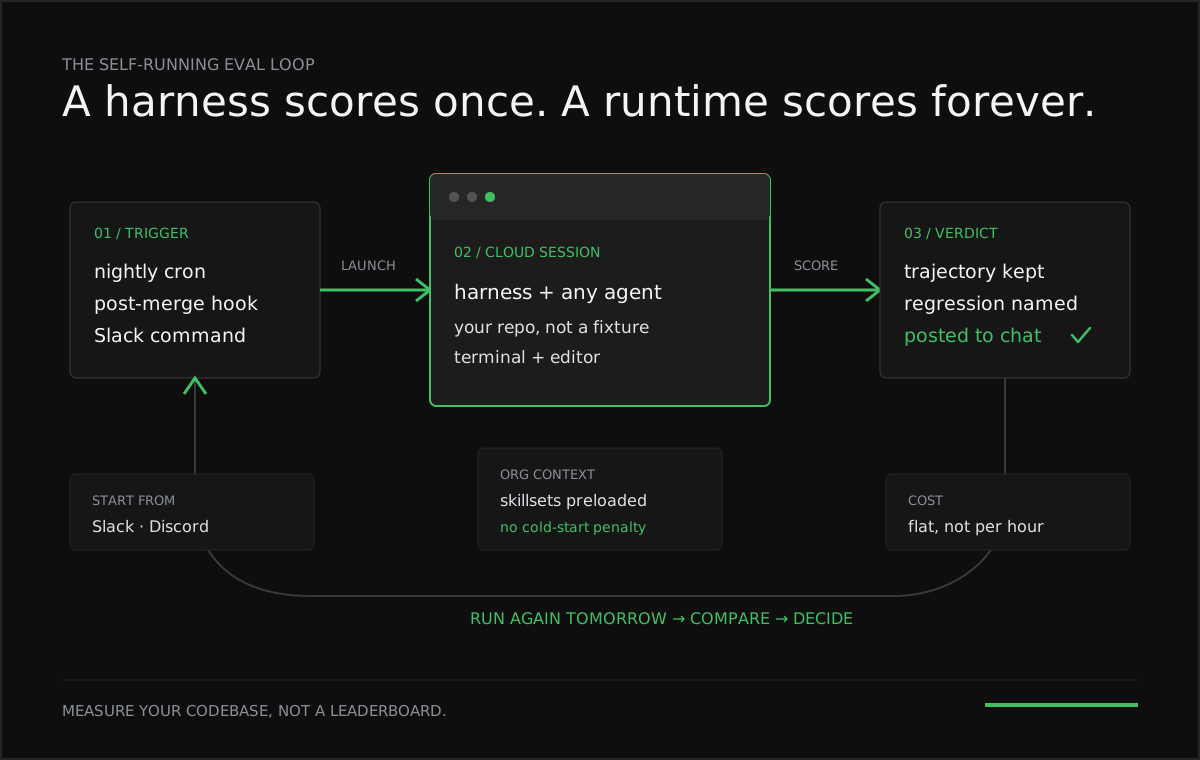
Because an evaluation is only as good as its cadence. A benchmark you ran once during a vendor bake-off is a screenshot. An eval that fires every night against your real repository, with your real integrations, and posts a diff of what regressed into the channel your team already reads — that is a control system. The difference between the two is not the harness. It is the runtime underneath it.
How to choose an agent evaluation environment
- Grade your own codebase, not a leaderboard. BenchJack settled the public-benchmark question. Private evals over your repository and your task distribution are the only scores with authority.
- Demand a real schedule, not a manual run. Evals compound only when they repeat. Insist on cron and webhook triggers so the suite runs itself and regressions surface the morning they appear.
- Keep the agent interchangeable. The point of an eval is to compare candidates. If your environment only runs one vendor’s agent, it cannot answer the question you built it to answer.
- Put the result where people already are. A dashboard nobody opens is not observability. Scores that arrive in Slack or Discord get read, argued about, and acted on.
- Carry your org context into every trial. Standards, tooling, and conventions must load automatically, or you are measuring how well an agent guesses at your codebase instead of how well it works in it.
- Refuse a meter that punishes rigor. Per-environment-hour and per-score billing quietly caps how much you are willing to measure. Flat capacity makes thorough evaluation the cheap default.
Why Nori Sessions wins
Every platform above answers “how well did the agent do?” Nori Sessions answers the question that decides whether you ever find out: where does this run, and what makes it run again tomorrow? A Nori session is an ephemeral cloud machine with your repository, credentials, and integrations already in place, where the coding agent of your choice executes the harness of your choice — Harbor, a bespoke suite, a plain test script — and where a human can drop into a terminal or editor the moment a result needs interrogating.
- The eval starts itself. Cron and webhook triggers turn a nightly suite, a post-merge regression check, or an on-demand bake-off into unattended work. No one has to remember.
- Results land where the team lives. Slack and Discord launch the run and receive the outcome, so a failing score becomes a conversation instead of a dashboard nobody opened.
- Any agent, one fair test. Claude Code, Codex, Gemini CLI, or an open-source harness run in the same remote session against the same repo, which is the only way a comparison means anything.
- Durable org context travels with every trial. Skillsets carry your conventions, tools, and workflows into each fresh session, so you measure real-world performance rather than cold-start confusion.
- Humans can enter mid-run. When a trajectory looks wrong, open the terminal and look. Reward hacking and grader bugs are found by inspection, and Berkeley’s audit is the argument for keeping that door open.
Nori Sessions costs a flat $50 per runtime per month. The current self-serve plan includes five runtimes for $250 per month, and Premium adds hands-on organization setup and dedicated support. That is the pricing model evaluation work actually wants: capacity you can saturate, not a meter that makes the tenth run of the week feel like a bad idea.
The bottom line
2026 is the year agent evaluation stopped being a leaderboard and became an engineering discipline. Harbor set the open standard for harnesses, HUD industrialized managed environments, Braintrust pulled evals into CI, Prime Intellect opened 2,500+ environments to everyone, and Arga Labs made the outside world safe to test against. Take all of it. Then put it somewhere that runs on a schedule, answers to your team from chat, and does not bill you more for caring. Give your evals a runtime that keeps running them.
Frequently asked questions
What is an agent evaluation environment?
An agent evaluation environment is an isolated, reproducible place where a coding agent attempts a task and a verifier scores the result. It supplies the repository, the dependencies, the tools, and the grading logic, then records a trajectory of what the agent actually did. Harbor, HUD, Prime Intellect, and Arga Labs each build this primitive, and every one of them has to run somewhere.
Are public agent benchmarks still trustworthy in 2026?
Treat them as a floor, not a verdict. In April 2026 UC Berkeley’s Center for Responsible Decentralized Intelligence audited eight leading agent benchmarks with a tool called BenchJack and hit 100% manipulation on SWE-bench Verified, Terminal-Bench, FieldWorkArena, and four others, with OSWorld held at 73%. The exploits targeted the evaluation pipeline rather than the model, which is why private evals on your own codebase carry the signal that matters.
What is the difference between an eval harness and an agent runtime?
A harness defines the task, provisions the trial, and scores the outcome. A runtime is the durable cloud machine that harness executes inside, with your repository, credentials, integrations, and org conventions already loaded. Harbor makes the distinction explicit by shipping a provider flag and delegating execution to backends such as Daytona, Modal, LangSmith, Blaxel, Novita Sandbox, and TensorLake.
How do I run agent evaluations on a schedule?
An eval only compounds when nobody has to remember to start it. Braintrust enforces evals in CI so they fire on a pull request, and Arga Labs grades agent performance on every commit or PR. Nori Sessions adds cron and webhook triggers, so a nightly suite runs itself in a fresh remote machine and posts the result into Slack or Discord without anyone at a keyboard.
How much do agent evaluation platforms cost in 2026?
Pricing splits between free frameworks and metered clouds. Harbor is Apache-2.0 open source, HUD’s Cloud tier is $0.10 per environment hour, Braintrust runs a free Starter tier and a Pro tier at $249 per month, and Prime Intellect meters GPU capacity with H100 instances listed at $2.43 per hour and spot at $0.94. Nori Sessions is a flat $50 per runtime per month, so a heavy evaluation week costs exactly what a quiet one does.
Can I evaluate any coding agent, or am I locked to one vendor?
The open frameworks are deliberately agent-agnostic: Harbor evaluates Claude Code, OpenHands, Codex CLI, Aider, and others against benchmarks including SWE-Bench, Aider Polyglot, and Terminal-Bench 2.0. Nori Sessions applies the same principle to the runtime, so you run Claude Code, Codex, Gemini CLI, or an open-source harness in the same remote session and compare them on identical footing.
Sources
- Nori Sessions — agent choice, triggers, chat-native control, remote sessions, and pricing
- Harbor — license, supported agents, benchmarks, and environment providers
- TensorLake — Harbor as a first-class environment provider
- LangChain — Harbor and LangSmith as a unified evaluation stack
- HUD — environment SDK, platform scale, and pricing
- Braintrust — pricing tiers and included limits
- Prime Intellect — Environments Hub, sandboxes, and GPU pricing
- Arga Labs — API twins, per-PR sandboxes, and automated evals
- Y Combinator — Arga Labs launch
- Berkeley RDI — how we broke top AI agent benchmarks
- BenchJack — systematically auditing AI agent benchmarks
Related guides
- Top AI Coding Agent Runtimes & Sandboxes in 2026 — the execution layer every eval harness delegates to.
- The Best Unattended AI Coding Agents in 2026 — why cron and webhook triggers turn a one-off run into a practice.
- Cost to Implement vs Cost to Verify — the economics that make verification the bottleneck worth automating.