The bottleneck moved again. In 2025 the question was whether a coding agent could finish a task at all. In 2026 the agents are good enough that one engineer can keep five, ten, a hundred of them busy — and the new bottleneck is running the fleet. Watching one agent grind through one ticket in one terminal is a waste of a capable model and a capable human. The tools that matter now let you fan agents out, keep them from colliding, and review their work as it lands.
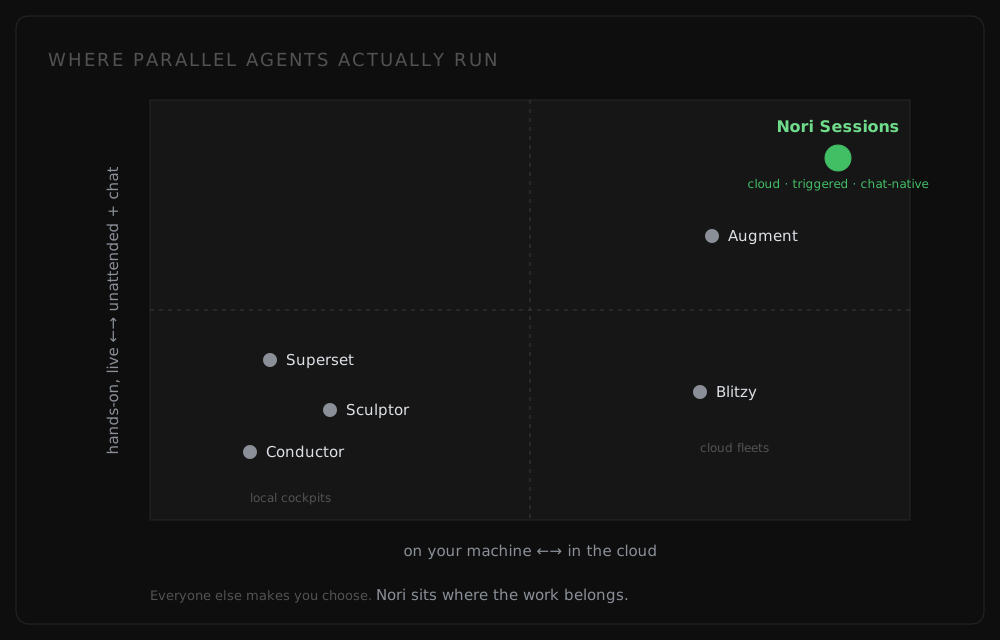
A real market has formed around this, and it splits cleanly into two camps. On one side are the local cockpits — Conductor, Sculptor, Superset — gorgeous desktop apps that spin up a dozen agents across git worktrees or containers on your own machine. On the other are the cloud fleets — Augment, Blitzy — that move the agents off your laptop entirely. Each camp fixes something real and gives up something real. Here is how the leaders stack up, and why Nori Sessions is the one that runs your fleet where the work actually belongs.
The parallel-agent field
Conductor, from Melty Labs (the YC S24 team behind the open-source Melty editor), is the cleanest expression of the local cockpit. It is a native macOS app, and its pitch is that all your code stays on your machine: every agent works in its own git worktree on its own branch, so parallel agents never step on each other (Conductor docs). It drives Claude Code, Codex, and Cursor using whatever login you already have, and the app itself is free — you only pay for the underlying AI (Conductor). It is a lovely way to run several agents at your desk. But it is macOS-only, it runs while you watch, and there is no way to trigger it on a schedule or drive it from Slack — close the laptop and the fleet stops.
Sculptor, from the research lab Imbue, takes the same local-first idea and hardens the isolation. Instead of worktrees, every agent runs in its own container, “so they can all execute code safely in parallel” without touching your environment, and a Pairing Mode syncs a container back into your IDE for live testing (Sculptor). It runs Claude Code today, adds Codex through an OpenAI API key, and is free during its beta while you bring your own Anthropic access; it ships for Apple Silicon Macs and Linux, with Intel Mac and Windows still to come (Sculptor on GitHub). Containers are a real safety upgrade over worktrees — but it is still a single-machine, hands-on tool with no scheduled runs and no chat control.
Superset is the ambitious newcomer — a Y Combinator–backed startup billing itself as “the code editor for AI agents,” already past 12,000 GitHub stars. It is an open-source desktop app that leans hard into scale: “orchestrate 100+ coding agents in parallel,” each in its own isolated git worktree, and it is proudly agent-agnostic — Claude, Codex, Cursor, OpenCode, Copilot, Amp, Gemini, and more, all under one roof (Superset). If you want the widest local cockpit for the most agents at once, this is the one to watch. It is still, however, anchored to your machine, interactive, and without a documented trigger or chat surface for unattended work.
Augment Code is the strongest of the cloud fleets. Its Remote Agents — now folding into a platform it calls Cosmos — run asynchronously in the cloud across the whole software lifecycle, from first commit through a review-ready pull request, and you keep the merge decision (Augment Remote Agents). Crucially, it does the things the local cockpits cannot: a Slack app you can mention to start a session, plus lifecycle and GitHub Actions webhook triggers (Augment Slack docs). The catch is lock-in and altitude: you run Augment’s agent, on Augment’s enterprise-priced rails — the Business plan is $100 per month flat, and everything above it is a custom enterprise deal aimed at the likes of Adobe and MongoDB (Augment pricing).
Blitzy plays a different game entirely: enterprise long-horizon automation at massive parallelism. It reverse-engineers your codebase into a knowledge graph, then coordinates “thousands of agents in parallel” through hours of sustained reasoning — over 100,000 model calls in a single run — to build or modernize codebases from one million to a hundred million lines (Blitzy). It raised $200M at a $1.4B valuation in May 2026, and posts a 66.5% score on SWE-Bench Pro (SiliconANGLE). But this is batch, not sessions: you write a spec, approve a plan, and come back to generated code. There is no interactive workspace to drop into, no chat-native control, no cron or webhook surface, and pricing is enterprise-only on request. It is a factory, not a cockpit.
And the space keeps filling in: 2026 also brought local terminals and boards like Baton, cmux, and Parallel Code, all of them fanning CLI agents across git worktrees on your own machine. The pattern is unmistakable — everyone agrees you should run many agents at once. The disagreement is where.
How they compare
| Platform | Where agents run | Parallelism model | Chat-native control |
Unattended triggers (cron / webhook) |
Pricing model |
|---|---|---|---|---|---|
| Conductor | Your Mac | Local git worktrees | ✗ | ✗ | Free app, BYO agent |
| Sculptor | Your machine | Local containers | ✗ | ✗ | Free beta, BYO agent |
| Superset | Your Mac | Git worktrees, 100+ | ✗ | ✗ | Open source; paid tier |
| Augment | Their cloud | Async cloud workers | Slack | ✓ webhook | $100/mo flat, then enterprise |
| Blitzy | Their cloud | Thousands, batch | ✗ | ✗ | Enterprise (contact sales) |
| Nori Sessions | Cloud, any agent | Parallel cloud sessions | ✓ Slack + Discord | ✓ cron + webhook | Flat $50 / runtime / mo |
Publicly reported capabilities and pricing as of July 2026. See sources below.
How to choose a parallel-agent platform
Six questions separate a tool you babysit from a fleet that runs itself:
- Where do the agents run? A cockpit on your Mac is only as available as your laptop. If the agents run in the cloud, the fleet keeps working through the night, the commute, and the closed lid.
- Can it run without you watching? Interactive parallelism is a productivity boost. Cron and webhook triggers are a different category — overnight dependency bumps and alert-driven fixes that launch themselves, no human, no dashboard.
- How do you control it? A desktop window ties you to one seat. Kicking off and steering agents from Slack or Discord means the whole team can drive the fleet from where they already work.
- Are you locked to one agent? Platforms that run their own agent hand you a model and a workflow. A runtime that runs any agent lets you swap Codex for Claude Code without re-tooling your fleet.
- Does the fleet know your org? Ten agents that each rediscover your test command and review norms are ten times the wasted setup. Durable, preloaded context is what makes a fleet act like it works here.
- Can you forecast the bill? Usage meters and enterprise contracts punish scale — the more agents you run, the scarier the invoice. A flat per-runtime line is what lets a team actually grow the fleet.
Every tool above nails one or two of these. Only one nails all six.
Why Nori Sessions wins
Nori Sessions gives you the parallelism of the local cockpits without chaining it to a laptop, and the cloud execution of the fleets without the lock-in or the enterprise invoice. Every session is an ephemeral cloud machine, and you run as many in parallel as the work demands:
- The fleet lives in the cloud. Each agent runs in its own isolated cloud session, not on your hardware. Spin up ten in parallel, close your laptop, and every one of them keeps working.
- Triggers are first-class. Cron and webhook triggers launch sessions with no human attached — nightly maintenance, alert-driven fixes, scheduled reviews. This very article was researched and opened as a pull request by a scheduled Nori Session.
- Chat-native on Slack and Discord. Start, steer, and check on your agents from the tools your team already lives in — and drop into a full terminal and editor the moment a human wants to take the wheel.
- Bring any agent. Run Codex, Claude Code, Gemini, Cursor Agent, or your own harness inside the same session. No lock-in to one vendor’s model or workflow.
- Every session knows your org. Durable skillsets preload your conventions, tools, and integrations onto every fresh machine, so the tenth agent is as informed as your best engineer, not a blank slate.
And instead of usage meters or enterprise minimums, Nori Sessions is a flat $50 per runtime per month, with a Premium tier that adds hands-on org setup and dedicated support. Growing the fleet is a line finance can predict, not a bill that grows teeth every time you succeed.
The bottom line
If you want a beautiful cockpit to run a few agents at your desk, Conductor, Sculptor, and Superset are excellent — and Superset scales the furthest of the three. If you are an enterprise that wants a managed cloud agent, Augment is strong; if you need to modernize a hundred-million-line monolith in a batch run, Blitzy is built for exactly that. But if what you actually want is a fleet of coding agents running in the cloud — unattended on triggers, driven from Slack and Discord, running any agent you choose, loaded with your org’s context, at a price a team can budget — you do not want a cockpit or a factory. You want the runtime. That is Nori Sessions, and it is already shipping.
Spin up your first Nori Session and put your whole fleet to work.
Frequently asked questions
What is a multi-agent orchestration or parallel-agent platform?
It is a tool that lets one developer run many coding agents at the same time and manage them from a single place, instead of babysitting one agent in one terminal. Each agent gets an isolated workspace so they do not overwrite each other, and you review their output as it lands. The platforms differ mainly in where the agents run — on your own machine or in the cloud — and in how much control and automation they wrap around the fleet.
Can you really run multiple coding agents at once?
Yes, and isolation is what makes it safe. Conductor and Superset give each agent its own git worktree, so parallel agents work on separate branches without merge collisions. Sculptor gives each agent its own container so they can execute code in parallel without touching your machine. Cloud platforms like Augment and Nori Sessions run each agent in its own sandboxed cloud environment. The mechanism varies, but the goal is the same: many agents working concurrently, each in a box of its own.
Do parallel-agent tools run on my machine or in the cloud?
Both models exist. Conductor, Sculptor, and Superset are local cockpits — desktop apps that fan agents out across worktrees or containers on your own Mac, so the fleet stops when you close the lid. Augment, Blitzy, and Nori Sessions run the agents in the cloud, off your hardware, so work continues whether or not your laptop is open. Cloud execution is what makes unattended, scheduled, and chat-triggered runs possible.
Can I run different agents in parallel, or am I locked to one vendor?
It depends on the tool. Conductor, Sculptor, and Superset are agent-agnostic — you point them at Claude Code, Codex, or others and bring your own subscription. Augment and Blitzy run their own agent and workflow, so you get that vendor’s model. Nori Sessions is a runtime rather than an agent: you can run Codex, Claude Code, Gemini, Cursor Agent, or your own harness inside the same session, so you keep your setup when you switch models.
How much do parallel-agent platforms cost in 2026?
The local cockpits are cheap or free: Conductor and Sculptor are free today and you bring your own agent subscription, and Superset is open source with a paid tier. Cloud platforms cost more: Augment’s Business plan is $100 per month flat with usage included, and Blitzy is enterprise-only with pricing on request. Nori Sessions is a flat $50 per runtime per month, with a Premium tier that adds hands-on org setup and dedicated support.
Do parallel-agent platforms run unattended on a schedule?
Most do not. The local cockpits are interactive by design — they run while you watch. Blitzy runs long, but as batch jobs you kick off, not on cron or webhooks. Augment offers software-lifecycle and webhook triggers, and Nori Sessions makes cron and webhook triggers first-class, so overnight and event-driven work launches itself with no human attached. This very article was researched and opened as a pull request by a scheduled Nori Session.
Sources
- Conductor (Melty Labs)
- Conductor docs — git worktrees
- Sculptor (Imbue) — parallel containers
- Sculptor on GitHub (platform support)
- Superset — orchestrate 100+ agents
- Superset Launch HN
- Augment Code Remote Agents / Cosmos
- Augment Slack triggers (docs)
- Augment pricing
- Blitzy — how it works
- Blitzy $200M raise — SiliconANGLE
- Baton — parallel CLI agents
- cmux — native macOS agent terminal
- Parallel Code