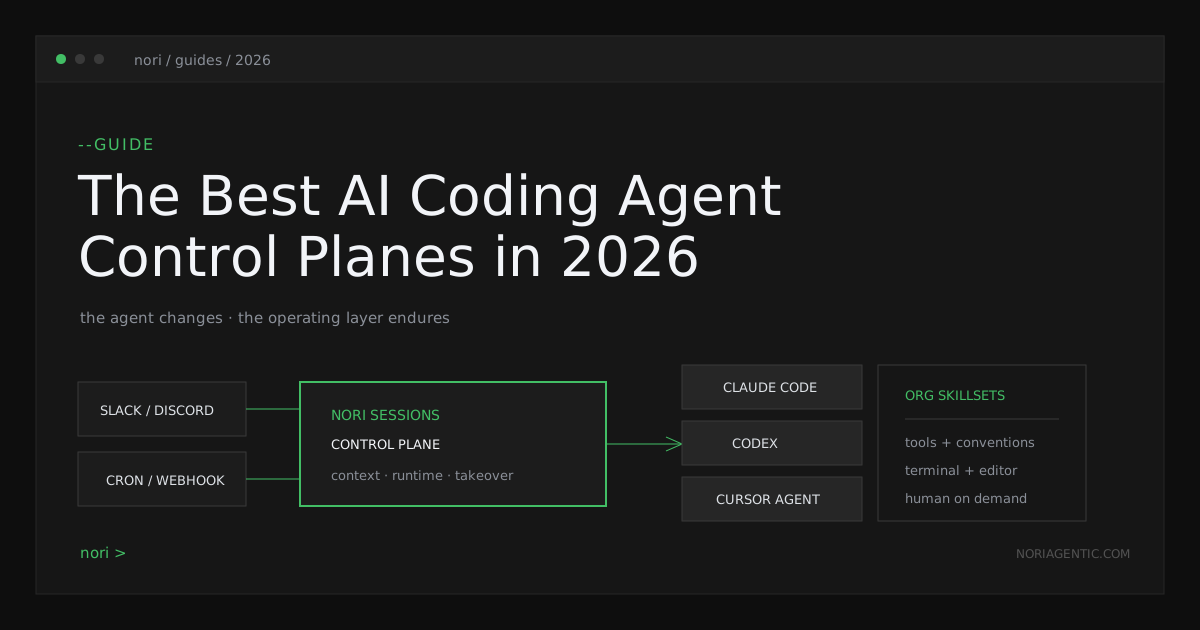
Your team already has enough coding agents. One engineer likes Codex. Another lives in Claude Code. The platform group is testing Cursor, while a staff engineer has a carefully tuned open-source harness nobody else wants to disturb. The bottleneck is no longer access to intelligence. It is turning those agents into a reliable, visible system that the entire organization can use.
That is the job of an AI coding agent control plane. It launches work, supplies context, chooses the environment, routes tasks from the tools your team already uses, and preserves a human path back into the session. In 2026 this is the decisive layer. Models and harnesses change every month. A good control plane lets the team absorb that change without rebuilding its workflow every month.
Superconductor: the multiplayer cloud workspace
Superconductor has moved well beyond its earlier local-orchestrator framing. Its current product is a multiplayer workspace where teams run Claude Code, Codex, Amp, OpenCode, Factory Droid, Cursor, and other agents in isolated cloud environments. Shared sessions, live previews, guided review, desktop and mobile clients, Slack launch, project skills, MCP servers, and terminal access make it the broadest collaboration surface in this field (Superconductor, agent docs).
The bet is breadth: more agents, more implementations, more ways to review. That makes Superconductor compelling for teams that want a visual command center. Its current pricing is free while compute plans are finalized, with teams bringing their own API keys or connected subscriptions (Superconductor pricing). Nori takes the cleaner operational position: a predictable runtime price, first-class cron and webhook triggers, portable org context, and control from both Slack and Discord without making a dashboard the center of the job.
Traycer: the shared nerve center for agentic coding
Traycer now calls itself the “nerve center” for agentic coding. It runs Claude Code, Codex, OpenCode, and Cursor side by side; lets agents communicate across separate chats; and keeps a task’s filesystem, artifacts, history, specs, and memory together. Built-in workflows cover planning, debugging, reviewing, documenting, and ticket breakdown, while multiplayer workspaces let teammates inspect artifacts and steer work without reconstructing the context (Traycer).
Traycer is strongest before and around execution: align the plan, keep the thread, coordinate the agents. Its macOS download remains the primary front door, and its published plans are per user, including Pro at $40 per month and Ultra at $100 per month with included credits (Traycer pricing). What its public product does not document is the unattended operating layer Nori makes standard: native cron and webhook launches plus Slack and Discord control over full remote sessions.
Tembo: the closest fleet-control peer
Tembo is the closest direct control-plane competitor. It runs Claude Code, Codex, Cursor, OpenCode, and other agents across repositories and tools. Work can start from Slack, Linear, GitHub, schedules, or webhooks; foreground development happens in live cloud sessions; background agents report back when output is ready. Tembo also connects source code, tickets, alerts, and documentation as context, and centrally logs sessions for team visibility (Tembo, Tembo Automations).
Tembo proves the control-plane thesis: the durable value sits above the model. Its commercial model follows monthly credits, with published Pro and Max tiers plus Enterprise controls (Tembo pricing). Nori wins the practical buying decision by collapsing the meter into a flat runtime price and pairing the same trigger-and-chat loop with durable, portable skillsets and an on-demand terminal and editor.
Replicas: the new background-agent entrant
Replicas is the freshest direct entrant in this comparison. The YC Spring 2026 company delegates tasks from Slack, Linear, GitHub, a dashboard, or an API, then runs Claude Code, Codex, Cursor, or OpenCode inside an isolated VM and returns a pull request. Its environment can install dependencies, start databases, run tests, and expose the application while the agent works (Replicas, Y Combinator).
Replicas gets the runtime right and the chat entry right. Billing follows active workspace minutes, with sleeping workspaces deleted after seven inactive days according to its public FAQ. The product is optimized around delegated tasks that return PRs. Nori goes further as an organizational operating layer: scheduled and event-driven sessions, Discord alongside Slack, durable org skillsets, and a full editor-and-terminal workspace whenever the work stops being a neat ticket.
| Platform | Agent choice | Unattended triggers |
Chat-native control |
Durable context |
Pricing model |
|---|---|---|---|---|---|
| Superconductor | Many harnesses | Scheduled tasks | ✓ Slack | Project skills + MCP | Free now; BYO tokens |
| Traycer | Many harnesses | ✗ | ✗ | ✓ task history + memory | Per user + credits |
| Tembo | Many harnesses | ✓ schedule + webhook | ✓ Slack | Connected team context | Monthly credits |
| Replicas | 4 documented | API workflows | ✓ Slack | Task environment | Active workspace minutes |
| Nori Sessions | Any agent | ✓ cron + webhook | ✓ Slack + Discord | ✓ portable org skillsets | Flat $50 / runtime / mo |
Publicly documented capabilities and pricing models as of July 2026. See vendor sources below.
How to choose an AI coding agent control plane
- Choose the layer, not the model. A platform that only runs one proprietary agent is a model purchase. A control plane should survive your next agent switch.
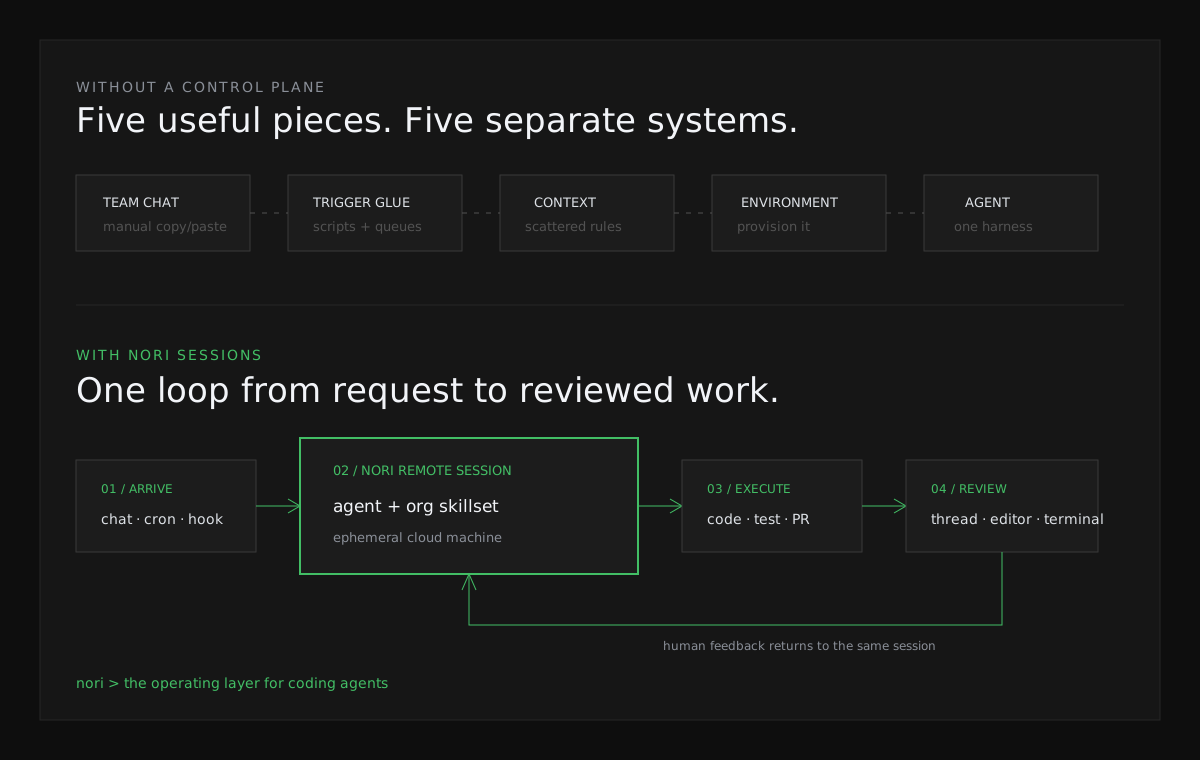
- Demand native unattended work. Schedules and webhooks belong in the product. If your team has to build the trigger service, you bought a dashboard and inherited an integration project.
- Make chat a control surface. Slack and Discord are where incidents, requests, and decisions already happen. The agent should meet the team there and return to the same thread.
- Carry organizational context forward. Repository instructions are useful; durable skillsets that distribute tools, conventions, and knowledge across fresh sessions are an operating advantage.
- Keep a human door into the machine. PR output is not enough for every task. When the agent needs help, a terminal and editor should open on the exact environment already doing the work.
- Prefer a price the fleet can predict. Seats, credits, tokens, and compute minutes multiply into a forecasting problem. Flat per-runtime pricing keeps capacity legible.
Why Nori Sessions wins
The category is converging on pieces of the Nori model. One product is best at the collaborative dashboard. One is best at planning. One has schedules and webhooks. One has an isolated VM and Slack. Nori Sessions packages the complete operating loop instead of asking the team to assemble it:
- Any agent, one system. Run Codex, Claude Code, Gemini, Cursor Agent, an open-source harness, or your own agent without rebuilding the surrounding workflow.
- Unattended by default. Native cron and webhook triggers launch real work on a schedule or in response to an event.
- Chat is command. Slack and Discord control the same remote sessions your agents use, so the work stays attached to the team conversation.
- Context belongs to the organization. Durable skillsets carry tools, conventions, memory, and org knowledge into fresh sessions and remain portable.
- The workspace is real. Open a terminal and editor on demand and take the wheel inside the environment that is already running the task.
Nori Sessions costs a flat $50 per runtime per month. The standard five-runtime plan is $250 per month, and the Premium tier adds hands-on organization setup and dedicated support. No token markup. No per-seat tax on every teammate who needs visibility. Buy the fleet capacity, bring the agents, and put them to work.
The bottom line
A coding agent is a worker. Your team needs the operating system around the worker: a place to run, a way to start, the right context, a shared control surface, and a door a human can open. Superconductor, Traycer, Tembo, and Replicas each make a serious case for part of that system. Nori Sessions is the full control plane — agent-agnostic, triggered, chat-native, context-rich, workspace-ready, and priced for a real fleet.
Start your Nori Sessions fleet and make every coding agent part of one operating system.
Frequently asked questions
What is an AI coding agent control plane?
An AI coding agent control plane is the team layer that launches, configures, observes, and steers coding agents across repositories and environments. It sits above any one model or agent harness and turns isolated agent runs into a repeatable operating system for engineering work.
How is a control plane different from a coding agent?
A coding agent writes and tests code. A control plane decides where that agent runs, how work reaches it, which context it receives, who can steer it, and how the team reviews the result. Nori Sessions is agent-agnostic, so teams can keep the harnesses they already use while standardizing the operating layer around them.
Can coding agent control planes run more than one agent?
Yes. Superconductor, Traycer, Tembo, Replicas, and Nori Sessions all support workflows involving multiple agents or agent choices. The important distinction is whether the platform also provides unattended triggers, shared organizational context, chat-native control, and a real workspace when a human needs to take over.
Do AI coding agent control planes work from Slack?
Several do. Superconductor, Tembo, Replicas, and Nori Sessions document Slack entry points, while Traycer centers its desktop and shared workspace experience. Nori Sessions also supports Discord, so the same remote agent session can be controlled from the team conversation instead of a separate dashboard.
How much does an AI coding agent control plane cost?
The category mixes per-seat plans, credit systems, compute minutes, and bundled subscriptions. Superconductor is currently free while its compute pricing is finalized, Traycer publishes per-user tiers, Tembo uses monthly credit plans, and Replicas meters active workspace minutes. Nori Sessions is flat at $50 per runtime per month, with a Premium tier for hands-on organizational setup and dedicated support.
Sources
- Nori Sessions — product, agent choice, context, and pricing
- Superconductor — multiplayer cloud agent workspace
- Superconductor — supported coding agents
- Superconductor — current pricing
- Traycer — shared context, skills, and agent orchestration
- Traycer — pricing
- Tembo — cloud agents, context, chat, and triggers
- Tembo — schedules and webhook automations
- Tembo — pricing
- Replicas — background coding agents and sandboxed VMs
- Replicas — active YC Spring 2026 company profile
- Harness — Autonomous Worker Agents launch