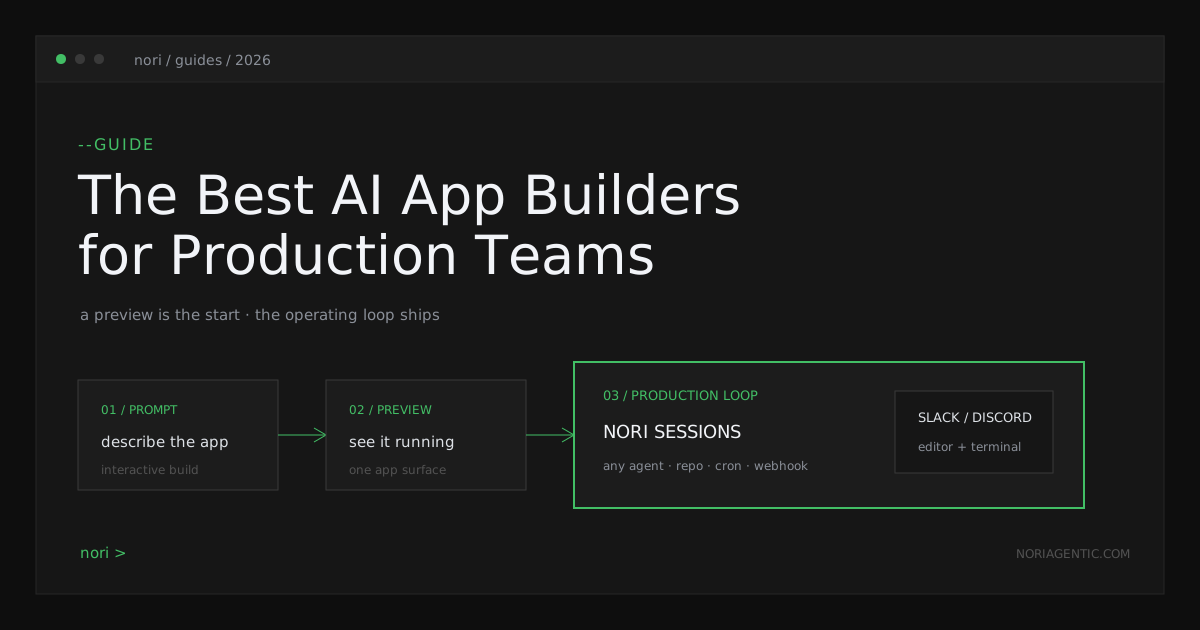
What is the best AI app builder for a production team in 2026?
It depends on where the app will live. For a new app with hosting included, Replit Agent or Lovable is fastest. For a Next.js app on Vercel, use v0. For a Firebase and Cloud Run stack, Google AI Studio Build mode is free to start. For agent work across existing GitHub or GitLab repositories with live previews, try Agen. App builders are weakest at ongoing work on repositories you already run; for that, pair one with an agent runtime such as Nori Sessions, which is not an app builder.
What an AI app builder is
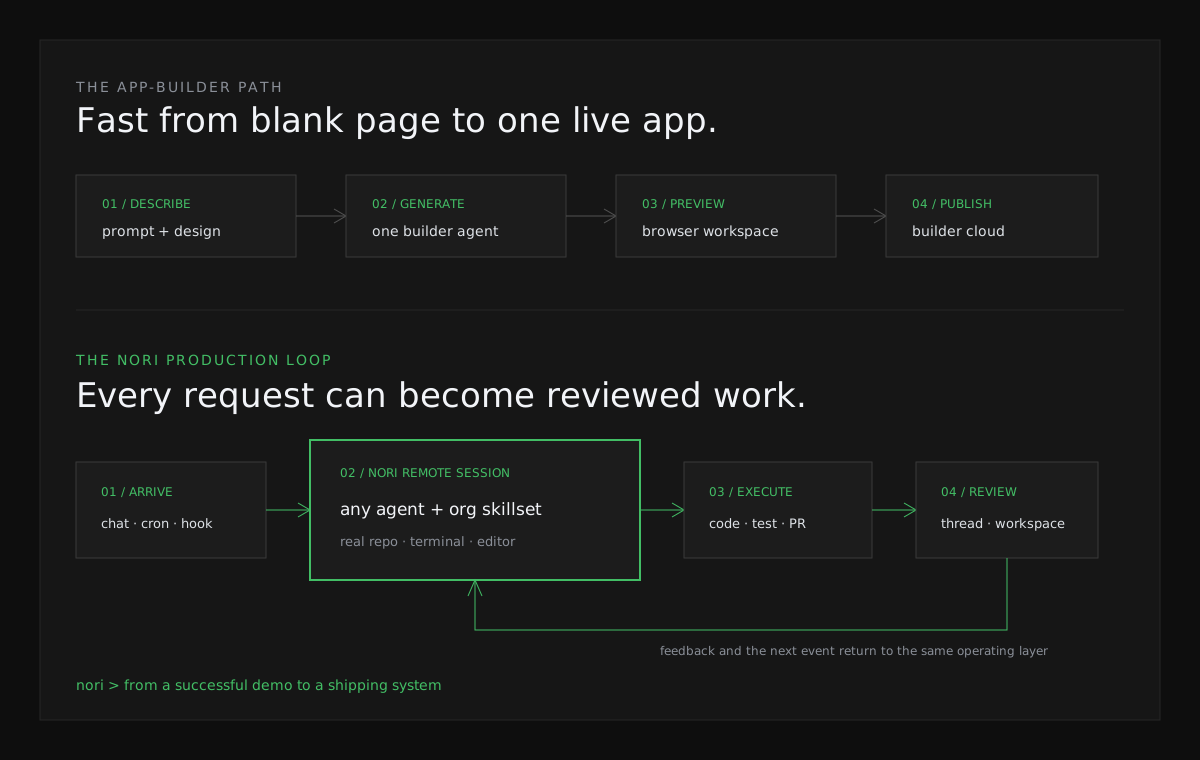
An AI app builder is a hosted product that turns a natural-language description into a working application. It generates the code, runs a live preview, and offers a path to publish, usually in a browser workspace with the vendor’s own agent doing the building. It is built for founders, product teams, designers, and engineers who want to get from idea to running software without setting up a project by hand. An agent runtime is a different category: it supplies the machines, triggers, credentials, and team context around whichever coding agent you choose, and it works on repositories you already own.
Production teams need both at different moments. The builder proves the idea. The runtime keeps the repository moving after launch: dependency bumps, failing CI, incident follow-ups, and the hundred small requests that arrive in chat.
Replit Agent: the all-in-one builder
Replit Agent builds full-stack apps inside a Replit project and publishes them through Replit. It imports public GitHub repositories quickly and private ones through a guided import, and it offers several agent modes (Free, Power, Max, Auto, and a faster Turbo mode that costs more). Replit also runs scheduled deployments on a cron schedule, billed for each run’s duration; that schedules your deployed app, not arbitrary coding work. As of October 2026, Core is $20 a month ($18 billed annually) with $20 of credits, Pro is $100 a month ($90 billed annually) with $100 of credits, 10 parallel agents, and 15 collaborators, and Enterprise is custom (Replit pricing, Agent docs). Pick Replit when you want one vendor to handle the editor, agent, and hosting.
Lovable: shared credits from prompt to cloud
Lovable builds web apps through conversation, publishes them, and syncs them to GitHub. Its sync always creates a new repository; to start from an existing codebase you import a ZIP, which copies the code into a new Lovable project (Lovable GitHub docs). Credits are shared across a workspace with unlimited members, and admins can cap each member’s use. As of October 2026, Pro starts at $25 a month ($21 billed annually) and Business at $42 a month billed annually, each with 100 credits at the base tier, and every plan gets 20 Lovable Cloud credits a month for hosting, database, storage, and compute (Lovable plans and credits). Lovable is the friendliest choice for non-engineers building a new web app.
v0: the Vercel-native path
v0 from Vercel imports GitHub repositories, works on a branch per chat, opens or reuses a pull request, and gives each branch a Vercel preview deployment (v0 GitHub docs). As of October 2026, Free allows 7 messages a day, Plus is $30 per user per month, Business is $100 per user per month and adds a training opt-out, and Enterprise is custom; Plus and Business include $30 of credits plus $2 a day per user, and models range from v0 Mini to v0 Max (v0 pricing). It is the sharp choice when the app already lives on Vercel.
Bolt: the fastest browser build loop
Bolt turns a prompt into a running app with hosting included on every plan. It can import an existing GitHub repository, commits automatically, and pulls GitHub changes every 30 seconds, while merges happen in GitHub (Bolt GitHub integration). Bolt Cloud is built on Netlify and Supabase, and Bolt picks models for you behind its Standard and Max agents (Bolt Cloud, Bolt agents). As of October 2026, Free includes 1M tokens a month, Pro is $18 a month billed annually with 10M tokens that roll over, Teams is $27 per member per month billed annually, and Enterprise is custom (Bolt pricing).
Google AI Studio Build mode: the Google Cloud path
Google AI Studio Build mode builds React and Node web apps and Kotlin Android apps from prompts, runs them in a live preview, and can set up Firestore and Firebase Auth. It imports GitHub repositories, supports two-way sync and ZIP export, and deploys to Cloud Run; the builder runs on Google’s Antigravity Agent (Build mode docs). Usage limits apply, and paid models and Cloud Run hosting can be billed (Gemini API pricing). Choose it when your team already runs on Google Cloud and Firebase.
Agen: cloud agents on your existing repositories
Agen sits closest to production work. Its agents clone your GitHub or GitLab repository into an isolated cloud sandbox, return pull requests, and can preview frontend, backend, and infrastructure changes together across several repositories (Agen). As of October 2026, plans are Core $10, Starter $59, Pro $119, and Scale $199 a month, with 20% off annually and overage at standard rates; scheduled agents (“Autopilot”) are on Pro and Scale only (Agen pricing). Agen does not describe hosting your app.
| Platform | Best for | Existing repo | Preview / delivery | Schedules | Entry price |
|---|---|---|---|---|---|
| Replit Agent | New full apps, hosted | ✓ GitHub import | Replit publishing | Scheduled deployments | Core $20/mo ($18 annual) |
| Lovable | Web apps for non-engineers | ZIP import into a new project | Lovable Cloud | ✗ none found | Pro from $25/mo |
| v0 | Next.js on Vercel | ✓ GitHub import + PRs | Vercel previews | ✗ none found | Plus $30/user/mo |
| Bolt | Fast browser prototypes | ✓ GitHub import | Bolt Cloud hosting | ✗ none found | Pro $18/mo (annual) |
| Google AI Studio | Firebase + Cloud Run apps | ✓ GitHub import + sync | Cloud Run | ✗ none found | Free with usage limits |
| Agen | Agent PRs on existing repos | ✓ GitHub / GitLab | Multi-repo live previews | Pro and Scale | Core $10/mo |
| Nori Sessions (runtime, not a builder) | Ongoing work on repos you own | ✓ your repositories | Your existing CI and hosting | ✓ cron + webhook | Developer $99/mo; no token charges |
Publicly documented capabilities and list prices as of October 2026. Prices exclude usage beyond included credits. See vendor sources below.
How to choose an AI app builder for a production team
- Start with the repository. If the code already exists, prefer a tool that imports it and opens pull requests (v0, Bolt, Google AI Studio, Agen) over one that copies it into a new project.
- Match the host. v0 fits Vercel, Google AI Studio fits Cloud Run and Firebase, and Replit, Lovable, and Bolt bundle their own hosting.
- Read the credit model. Every builder here combines a plan with credits, tokens, or usage. Estimate a busy month, not a demo.
- Decide who starts the work. Builders assume a person typing into the builder. Work from alerts, schedules, and chat needs triggers.
- Separate agent choice from platform choice. Each builder runs its own agent. Models change quickly, so keep the option to switch.
Where Nori Sessions fits
Nori Sessions is not an app builder and will not give you a one-prompt preview. It is the runtime for the work that follows: a cloud machine where your team’s chosen coding agent works on your own repositories, started from chat or an automation. Use it alongside a builder, or instead of one when the app already exists.
- Any harness. Claude Code, Codex, Gemini CLI, Cursor, OpenCode, Droid, Amp, Goose, or any ACP agent.
- Your own model access. Bring your Claude or ChatGPT subscription, API keys, or an LLM gateway. Nori never charges for tokens, so there is no markup and no provider lock-in.
- Work from where the team talks. Start and steer sessions from Slack, Discord, the web, or the CLI.
- Unattended runs. Cron and webhook automations launch work without a person opening anything.
- Opinionated defaults. Workflow skills, org skillsets, and memories load into every fresh session.
As of October 2026, Nori offers a free 30-day trial (5 runtimes, no card), Developer at $99 a month, Team at $250 a month, and custom Enterprise plans that bring your own compute, identity provider, and LLM gateway, in your cloud or on-prem. Teams have merged more than 100,000 pull requests with Nori. To compare Nori with other cloud coding agents, see cloud coding agents compared, Nori vs Devin, and Nori vs Cursor cloud agents.
Subscribe to the newsletter
Weekly updates and long-form essays from the Nori team on AI agents and the agent ecosystem.
The bottom line
Use an AI app builder to prove the idea: Replit or Lovable for an all-in-one start, v0 for Vercel, Google AI Studio for Google Cloud, Bolt for a fast prototype, and Agen when the code already lives in GitHub or GitLab. When the app becomes a repository your team maintains, add a runtime for the recurring work. Try Nori Sessions free for 30 days.
Frequently asked questions
How is an AI app builder different from an agent runtime?
An app builder centers one product's agent and build workflow, from prompt to preview to publish. An agent runtime centers the environment around whichever coding agent the team chooses, including the repository, triggers, integrations, and team context. Nori Sessions is an agent runtime, not an app builder.
Which AI app builders work with an existing GitHub repository?
As of October 2026, Replit Agent, v0, Bolt, and Google AI Studio document GitHub import, and Agen clones GitHub or GitLab repositories into cloud sandboxes. Lovable's GitHub sync always creates a new repository; existing code can only be imported as a ZIP into a new project.
Can AI app builders run coding work on a schedule?
Agen offers scheduled agents on its Pro and Scale plans. Replit offers scheduled deployments, which run your deployed app on a cron schedule rather than scheduling coding work. Nori Sessions runs cron and webhook automations that start the team's chosen coding agent without anyone opening a builder.
How much do AI app builders cost in 2026?
As of October 2026: Replit Core is $20 a month ($18 billed annually), Lovable Pro starts at $25 a month, v0 Plus is $30 per user per month, Bolt Pro is $18 a month billed annually, Agen starts at $10 a month, and Google AI Studio is free within usage limits. Most add credits or usage on top. Nori Sessions, a runtime rather than a builder, starts at $99 a month and never charges for tokens.
Which AI app builder is best for non-engineers?
Lovable and Replit Agent are the most approachable for non-engineers because they bundle the editor, agent, and hosting in one browser workspace. Engineering teams with existing repositories usually get more from v0, Agen, or a coding agent running in a runtime such as Nori Sessions.
Sources
Vendor pages were read on October 19, 2026 unless noted.
- Replit — pricing
- Replit — Agent modes
- Replit — import from GitHub
- Replit — scheduled deployments
- Lovable — GitHub integration
- Lovable — plans and credits
- Lovable — pricing
- v0 — GitHub integration
- v0 — pricing
- Bolt — GitHub integration
- Bolt — Bolt Cloud
- Bolt — agents
- Bolt — pricing
- Google AI Studio — Build mode
- Google AI Studio — Gemini API pricing
- Agen — product
- Agen — pricing
- Nori Sessions — product and pricing