What is the best durable context platform for AI coding agents in 2026?
It depends on which part of context you need to keep. For governed, versioned skills shared across many agents, Tessl is the most complete. For the reasoning behind each commit, Entire stores agent sessions alongside Git. For team memory distilled from agent traces, choose Octarin; for a free, self-hosted memory engine, Agentmemory. If your team already runs Devin, its Skills and Memory are built in. Nori Sessions fits when you want org skillsets and memories loaded into remote sessions that any harness can run, started from Slack, cron, or webhooks.
What is a durable context platform?
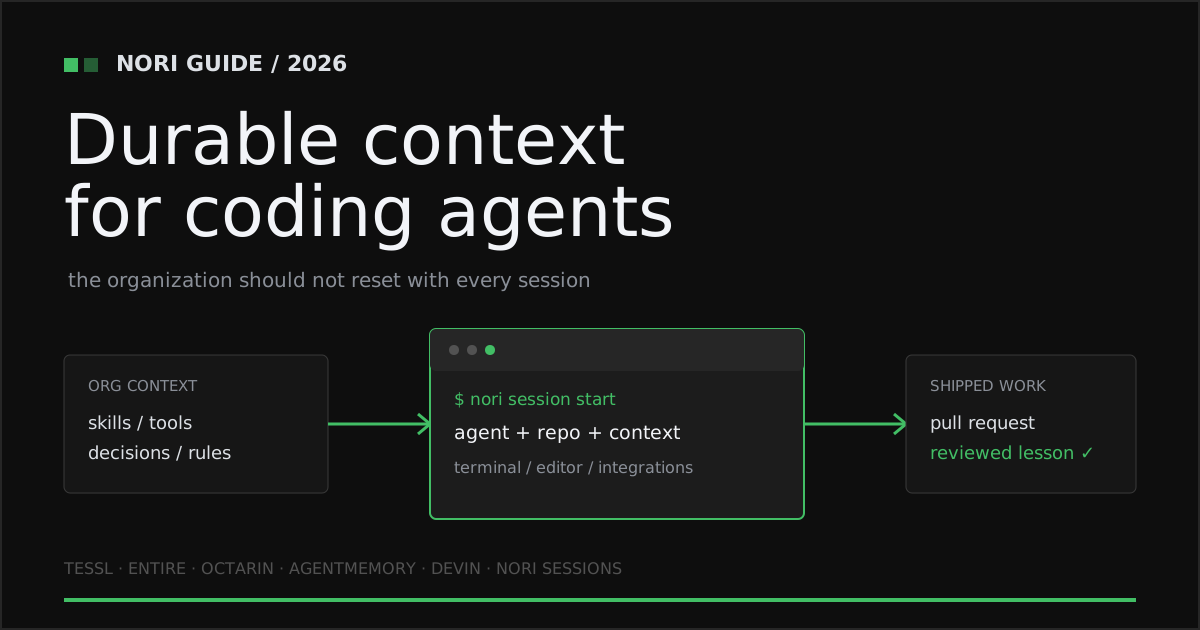
A durable context platform stores the knowledge a coding agent needs beyond a single prompt or session (repository conventions, architecture decisions, test and deploy procedures, and lessons from earlier runs) and hands it back to the next agent run automatically. It is for engineering teams that run coding agents every day and are tired of re-explaining the same rules. In practice the category takes four forms: skill registries that version and distribute instructions, session-history tools that attach agent transcripts to commits, memory engines that capture activity and recall it later, and full agent platforms with context built in.
The cost it removes is real. Every blank session taxes the team twice: senior engineers repeat what the organization already knows, then reviewers catch the mistakes that missing context created.
Tessl: governed skills as organizational software
Tessl treats agent skills like code: teams publish, install, review, and evaluate skills and plugins, and the platform includes its own Tessl agent. As of October 2026, Free is $0 with 1,000 credits a month, Team is $100 a month with 5,000 credits plus pay-as-you-go overage and agent and model choice per task, and Enterprise is custom. Enterprise adds the governance layer: install and publish policies, mandatory org standard skills, audit logs, SAML SSO, bring-your-own LLM, and single-tenant or self-hosted deployment (Tessl platform, pricing). If your main problem is controlling which skills every agent in a large org may install, Tessl is the strongest pick here.
Entire: session history attached to Git
Entire preserves the history behind the diff. Its MIT-licensed CLI captures prompts, tool calls, and conversations and links them to Git history; every commit an agent makes becomes a checkpoint pairing the code change with the conversation behind it, and secrets are redacted before storage. The docs list built-in support for Claude Code (the default), Codex, Cursor, Copilot CLI, Factory Droid, OpenCode, Pi, and Antigravity CLI, plus external agents discovered on your PATH. Entire also describes itself as Git hosting that stores agent sessions in your repo, with hosting in India, Australia, the EU, and the US; it publishes no pricing as of October 2026 (Entire overview, agent integrations). Pick Entire when reviewers need to know why code changed.
Octarin: team memory distilled from agent traces
Octarin, built by NACE AI, now describes itself as an open-source provenance layer for Git. It captures agent runs from tools such as Claude Code, Cursor, and Codex through native hooks, links each run to the commit or pull request it produced with files, lines changed, and cost, and distills durable decisions, conventions, and gotchas into memory shared org-wide, by group, or kept personal. Agents query that context through one private MCP endpoint. As of October 2026, Free covers 10M tokens a month, Solo is $9.99 for 35M, Team is $299 a month for 100M tokens then $6 per additional million, and Enterprise is custom with SSO/SAML (Octarin product and pricing). Octarin is the best fit when you want memory and spend attribution built from what agents actually did.
Agentmemory: a local, open memory runtime
Agentmemory is an Apache-2.0 memory engine for coding agents with about 29,700 GitHub stars as of October 2026. Hooks capture prompts, tool use, and session events; memories are consolidated across working, episodic, semantic, and procedural tiers and decay when unused; recall combines BM25, vector, and knowledge-graph search over MCP or REST. The README lists around 25 integrations, including Claude Code, Codex CLI, Copilot CLI, Cursor, Gemini CLI, OpenCode, Goose, and Cline. It runs locally on SQLite by default and can be deployed to Fly.io, Railway, Render, or Coolify (Agentmemory, source repository). It is the right choice for teams that want free, self-operated memory and are willing to run it.
Devin Skills and Memory: context inside a full agent
Devin is the closest full-platform comparison. Devin Skills are SKILL.md files committed to your repositories that teach Devin repeatable procedures, and they can be scoped to a repository, a person, an organization, or an enterprise. Memory saves preferences, corrections, and project lessons as Markdown notes in a Git repository; it is personal to each user, and a daily “dreaming” session merges and prunes notes. Admins can switch Memory on or off per organization or enforce it across an enterprise. Devin’s older Knowledge feature is marked deprecated and is being migrated to Skills (Devin Memory, Devin Skills, Devin Knowledge). The tradeoff is that this context runs only in Devin: plans run from Free to Max at $200 a month with Teams from $80 a month, usage draws on token quotas and on-demand credits, and Devin does not support third-party LLM API keys (Devin billing, Devin deployment). For a full side-by-side, see Nori vs Devin.
| Platform | Durable context | Org / team scope | Agent choice | Runtime + triggers | Pricing model |
|---|---|---|---|---|---|
| Tessl | Versioned skills + evals | ✓ governed registry (Enterprise) | Multiple agents; Tessl agent | Context layer | Free; Team $100/mo + credits; Enterprise custom |
| Entire | Git-linked sessions + checkpoints | Repository history | Multiple agents | Context layer | MIT CLI; no published hosted pricing |
| Octarin | Traces + distilled memory | ✓ org, group, or personal | Multiple agents via hooks + MCP | Context layer | Free; Solo $9.99; Team $299/mo; Enterprise custom |
| Agentmemory | Hybrid recall memory | Self-operated | ~25 agents via MCP / REST | Context layer | Apache-2.0; self-hosted |
| Devin | Skills + personal Memory | ✓ repo, org, enterprise skills | Devin only | ✓ Devin cloud, schedules, webhooks | Free to Max $200/mo; Teams from $80/mo; usage credits |
| Nori Sessions | Org skillsets, memories, workflow skills | ✓ organization | Any harness (Claude Code, Codex, Gemini CLI, ACP agents) | ✓ remote sessions; cron, webhook, Slack, Discord | Developer $99/mo; Team $250/mo; Enterprise custom; no token charges |
Publicly documented capabilities and pricing as of October 2026. See vendor sources below.
How to choose a durable context platform
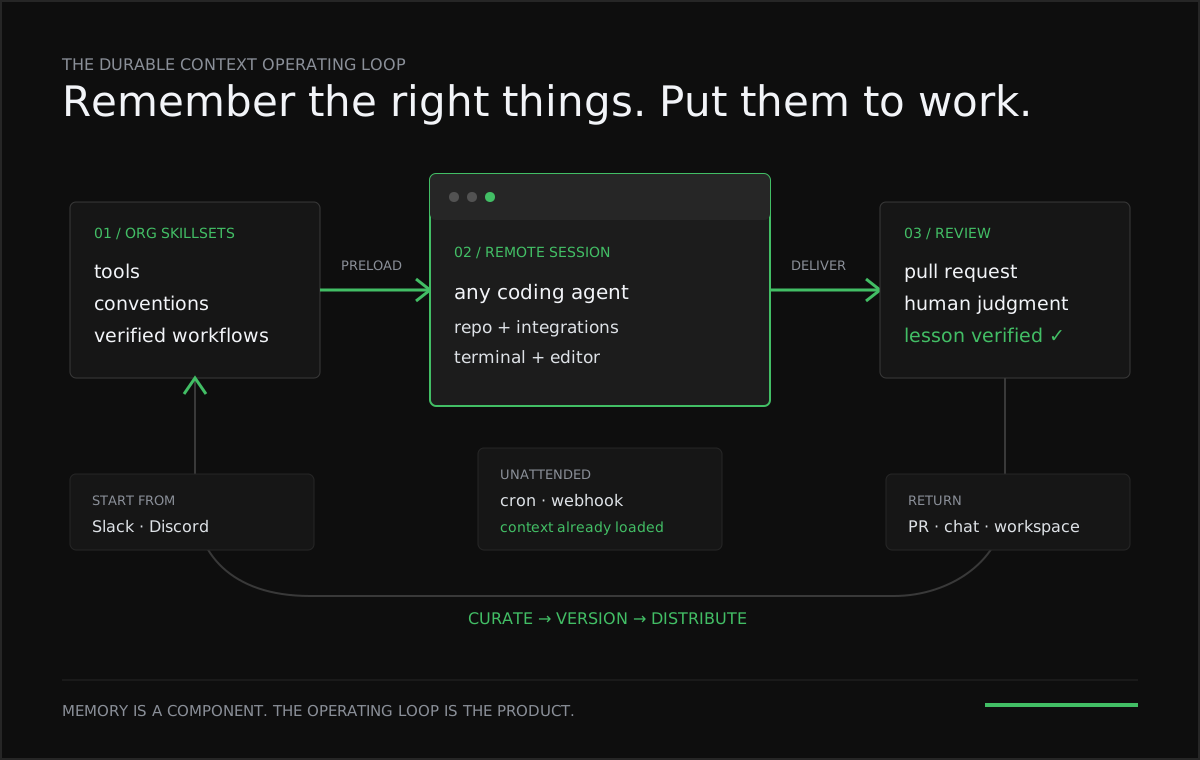
- Choose organizational memory over personal memory. The platform should carry standards, tools, and decisions to every authorized teammate and fresh session.
- Keep context portable. Agent vendors will change. Skills and org knowledge should survive the switch from one model or harness to the next.
- Prefer curated signal to transcript hoarding. Durable instructions, decisions, and verified workflows beat a giant archive of unfiltered scratch work.
- Decide whether you need a runtime. Context layers (Tessl, Entire, Octarin, Agentmemory) plug into agents you already run. Platforms like Devin and Nori Sessions also supply the machine the agent works on.
- Make context available to unattended work. Cron and webhooks matter because the best run is often the one nobody had to remember to start.
- Give the whole team a control surface. Slack and Discord let engineering, operations, and product steer work without learning another agent dashboard.
Where Nori Sessions fits
Nori Sessions is a remote runtime for coding agents, not a standalone memory product. Its durable context comes as opinionated defaults: org skillsets, memories, and workflow skills (plans, TDD, worktrees, review) that load into every session for every authorized teammate.
- Any harness. Run Claude Code, Codex, Gemini CLI, Cursor, OpenCode, or ACP agents such as Droid, Amp, and Goose with the same org skillsets.
- Bring your own model access. Use your Claude or ChatGPT subscription, API keys, or an LLM gateway. We never charge for tokens, so there is no markup and no provider lock-in.
- Work can start itself. Cron and webhook automations launch sessions; Slack, Discord, the web UI, and the CLI start and steer them.
- Enterprise control. Enterprise can bring its own memory provider, plus its own compute, IdP (SAML, SCIM, OIDC), LLM gateway, and token provider, in your cloud or on-prem.
Pricing as of October 2026: a free 30-day trial (5 runtimes, no card), Developer at $99 a month, Team at $250 a month, and custom Enterprise. Teams have merged more than 100,000 PRs with Nori.
When Nori is not the right choice: if you only need a governed skill registry, Tessl does that job more completely; if you need commit-level agent provenance, use Entire or Octarin; if you want a free memory engine on a laptop, Agentmemory costs nothing. Those layers can sit alongside Nori, because any memory system runs on the agent’s machine. To compare Nori against other remote agent platforms, see the cloud coding agents comparison, Nori vs Devin, and Nori vs Factory.
Subscribe to the newsletter
Weekly updates and long-form essays from the Nori team on AI agents and the agent ecosystem.
The bottom line
An agent that remembers but cannot act is a knowledge base. An agent that acts without organizational context is a recurring review problem. Pick the context layer that matches the knowledge you are losing today, and make sure it reaches the place where your agents actually run. Give every agent the organization’s context before it touches the code.
Frequently asked questions
What is durable context for an AI coding agent?
Durable context is the reusable knowledge an agent can carry beyond one prompt or session: architecture decisions, repository conventions, workflows, skills, and lessons from earlier work. The best systems make that context available again without forcing a teammate to repeat it manually.
How is durable context different from a long context window?
A context window holds information for the current model interaction. Durable context survives after that interaction ends and can be selected again for a later task, a different machine, or another agent. It is an organizational layer, not simply a larger prompt.
Can coding-agent context work across different agent vendors?
Yes, when the context layer uses portable files, skills, Git history, or a cross-agent protocol such as MCP. Entire, Octarin, Agentmemory, and Tessl all document multi-agent paths. Devin Skills are SKILL.md files in your repository, but inside Devin only Devin runs them. Nori Sessions loads org skillsets into whichever coding agent a session runs.
Does agent memory replace a cloud agent runtime?
No. A memory or skills layer can tell an agent what the organization knows, but it does not provide the remote machine, repository checkout, chat control, or unattended triggers where work happens. Devin and Nori Sessions pair context with a runtime; Tessl, Entire, Octarin, and Agentmemory are context layers you attach to agents you already run.
How much do durable context platforms cost in 2026?
As of October 2026: Agentmemory (Apache-2.0) and the Entire CLI (MIT) are open source; Tessl is free with 1,000 monthly credits, Team is $100 per month with 5,000 credits, and Enterprise is custom; Octarin is free, Solo $9.99, Team $299 per month for 100M tracked tokens, and Enterprise custom; Devin includes Skills and Memory in its plans from Free to Max at $200 per month. Nori Sessions has a free 30-day trial, Developer at $99 per month, Team at $250 per month, and custom Enterprise, and never charges for tokens.
Sources
- Nori Sessions — harness choice, org skillsets, automations, and pricing
- Tessl — agent skill lifecycle and governance
- Tessl — pricing
- Entire — Git-linked agent sessions and checkpoints
- Entire — supported coding agents
- Octarin — traces, shared memory, MCP, and pricing
- Agentmemory — agent memory runtime
- Agentmemory — source, license, and integrations
- Devin — Skills and Playbooks
- Devin — Memory and dreaming
- Devin — Knowledge (deprecated)
- Devin — self-serve plans and billing
- Devin — enterprise deployment and API keys