Devin, from Cognition, is the tool that made “the AI software engineer” a category. You hand it a ticket, it plans, writes code, runs the tests, fixes its own mistakes, and opens a pull request for a human to review — and it can do several of those at once. If you have been evaluating Devin, you already understand the appeal. You are here because you want to know what else is out there before you commit: who competes with Devin, where each option is genuinely stronger, and which one fits how your team actually works.
This is an honest field guide. Devin is a real, capable product, and we will say so plainly. But it makes one big assumption — that you want its agent, on its rails, billed by its meter. The alternatives below each relax a different one of those assumptions, and one of them, Nori Sessions, relaxes all three: it is a runtime that runs whichever agent you choose, on triggers, from chat, for a flat price. Let us start with Devin itself, then walk the alternatives.
What Devin is — and why people look for Devin alternatives
Devin is an autonomous coding agent that works asynchronously in its own cloud sandbox — a shell, a browser, and an editor — and reports back with a pull request (devin.ai). You drive it from a web app, from a Slack mention, from the CLI, or from its Windsurf-derived Devin Desktop, and you can spin up multiple “parallel Devins” to burn down a backlog. It is genuinely good at what it is built for: well-scoped, repetitive work — dependency bumps, framework migrations, JS-to-TS conversions, mechanical bug fixes — where the self-debugging loop (read the error, fix it, rerun the tests) does real work without a human in the seat. It also builds a living DeepWiki of your codebase that the agent reads from and writes to.
So why go looking for Devin alternatives and Devin competitors? A few honest reasons show up again and again in user reports. Output quality tracks how precisely you spec the task — a vague ticket yields a vague result (idlen review). Left unsupervised on open-ended work, it can over-engineer or make questionable architectural calls, and reviewers report it can get lost in very large or unfamiliar codebases. And it is Devin, only Devin: you run Cognition's agent, on Cognition's pricing, which moved to dollar-based quotas plus on-demand credits in April 2026 (Cognition pricing announcement). If you would rather bring your own agent, keep a predictable bill, or drop into a real workspace and take the wheel, it is worth seeing the field.
The best Devin alternatives in 2026
1. Nori Sessions — the runtime that runs any agent, unattended and chat-native
Every other tool on this list ships you an agent. Nori Sessions ships you the place the agent runs. Each session is an ephemeral cloud machine with a real terminal and editor, and inside it you run whichever coding agent you already trust — Codex, Claude Code, Gemini, Cursor Agent, or your own harness. That single design choice is why it is the strongest Devin alternative for most teams: you get autonomous cloud execution without being married to one vendor's model or workflow.
It also matches Devin on the automation that matters and then goes further. Cron and webhook triggers are first-class, so nightly maintenance, alert-driven fixes, and scheduled reviews launch themselves with no human attached — this very page was researched and opened as a pull request by a scheduled Nori Session. Control is chat-native on Slack and Discord, so the whole team can start, steer, and check on work from where they already are, then drop into the full terminal-and-editor workspace the moment a human wants to take over. Every session boots preloaded with your org's conventions and tools through durable skillsets, so the tenth run is as informed as your best engineer, not a blank slate. And the price is a flat $50 per runtime per month, with a Premium tier that adds hands-on org setup and dedicated support — a line finance can predict, not a usage meter that grows teeth as you scale.
2. OpenAI Codex — the autonomous agent baked into ChatGPT
Codex is OpenAI's cloud coding agent, available as a web app, a CLI, and an IDE extension, and bundled into ChatGPT plans (openai.com/codex). Like Devin, it runs tasks asynchronously in the cloud and produces code review and pull requests, and it is a natural Devin alternative if your team already lives in ChatGPT — cloud tasks are available from the Plus tier upward, with Slack and Linear integrations reserved for Business and Enterprise. Pricing rides the ChatGPT plans (Plus at $20/month, Pro from $100/month, Business around $25 per user), and OpenAI moved Codex to token-and-credit-based billing in April 2026 (Codex pricing). It is a strong async agent, but it runs OpenAI's model on OpenAI's rails and has no native cron or webhook trigger surface. (Full disclosure: the Nori CLI is itself a fork of Codex — it is good technology; the difference is that Nori runs it, and other agents, as a hostable runtime.)
3. Cursor Cloud Agents — background agents from the popular editor
Anysphere's Cursor added cloud “background agents” that work larger tasks asynchronously in hosted sandboxes and return merge-ready pull requests with screenshots and logs (cursor.com/cloud). Among the alternatives here it has one of the strongest automation stories: native Slack and Teams control (mention @Cursor in a thread), plus cron schedules and GitHub, Slack, Linear, and webhook triggers. Cursor Pro is about $20 per month, with the cloud agents billed on compute usage on top after a March 2026 shift to usage-based pricing (Cursor pricing). It is an excellent choice if you want your editor and your cloud agent from one vendor — the trade-off is that it runs Cursor's own agent, and the compute meter is another variable line on the bill.
4. GitHub Copilot coding agent — issue in, pull request out
GitHub's Copilot coding agent takes an assigned issue and returns a ready-to-review pull request, running in the background on GitHub Actions–backed infrastructure (github.com/features/copilot). If your work already flows through GitHub issues and PRs, it is the most frictionless Devin alternative to adopt — the agent lives exactly where your review does. It is available from the Pro tier ($10/month), through Pro+ ($39/month) and Business ($19/user/month), and moved to usage-based AI-credit billing in June 2026 (GitHub Copilot plans). The limits are the flip side of the tight GitHub integration: there is no native Slack or Discord control and no cron or webhook trigger for the agent, so it is issue-driven rather than schedule-driven.
5. Jules — Google's async agent on a cloud VM
Jules is Google's asynchronous coding agent, powered by Gemini: it clones your repository onto a cloud VM, plans, produces a diff, and opens a pull request (jules.google). It is a credible Devin alternative for teams in the Google ecosystem, and it has a genuine automation feature in native Scheduled Tasks (recurring, cron-like runs). Access comes through a free introductory tier and the Google AI Pro ($19.99/month) and Ultra ($124.99/month) subscriptions, which raise the daily task and concurrency limits (Jules usage limits). Chat control is thinner than the leaders: Slack and similar ChatOps run through the Jules API rather than a one-click native integration, and it runs Gemini, not an agent of your choosing.
6. OpenHands — the open-source agent you can self-host
OpenHands, from All Hands AI, is the strongest open-source option: a platform whose agents execute real engineering work in isolated sandboxes, available both as a free local open-source project and as a cloud SaaS (openhands.dev). Its cloud agents run in VM sandboxes even when your machine is off and open reviewable pull requests, and it advertises the ability to “schedule recurring tasks or trigger workflows from GitHub, Slack, or PagerDuty” — genuine cron, webhook, and chat triggers. Pricing is open-source-free to self-host, with the hosted individual tier billing model usage at cost and Enterprise priced on request (OpenHands pricing). If you want control, transparency, and the option to bring your own model, OpenHands is the Devin alternative to weigh — the trade-off is that self-hosting the sandbox infrastructure is now your problem to run.
How Devin and its alternatives compare
| Product | Type | Runs any agent |
Chat-native control |
Unattended triggers (cron / webhook) |
Pricing model |
|---|---|---|---|---|---|
| Devin | Autonomous agent | ✗ Devin only | Slack | ✓ cron + webhook | Pro $20 → Max $200/mo |
| OpenAI Codex | Cloud agent | ✗ Codex only | Slack (Business) | ✗ | Bundled with ChatGPT |
| Cursor Cloud | Background agents | ✗ Cursor agent | ✓ Slack + Teams | ✓ cron + webhook | ~$20/mo + compute usage |
| Copilot agent | Issue → PR agent | ✗ Copilot only | ✗ | ✗ | $10–$39 / user / mo |
| Jules | Async agent (Gemini) | ✗ Gemini only | via API | ✓ scheduled tasks | Bundled ($20–$125/mo) |
| OpenHands | Open-source agent | BYO model | ✓ Slack | ✓ cron + webhook | Open source; usage at cost |
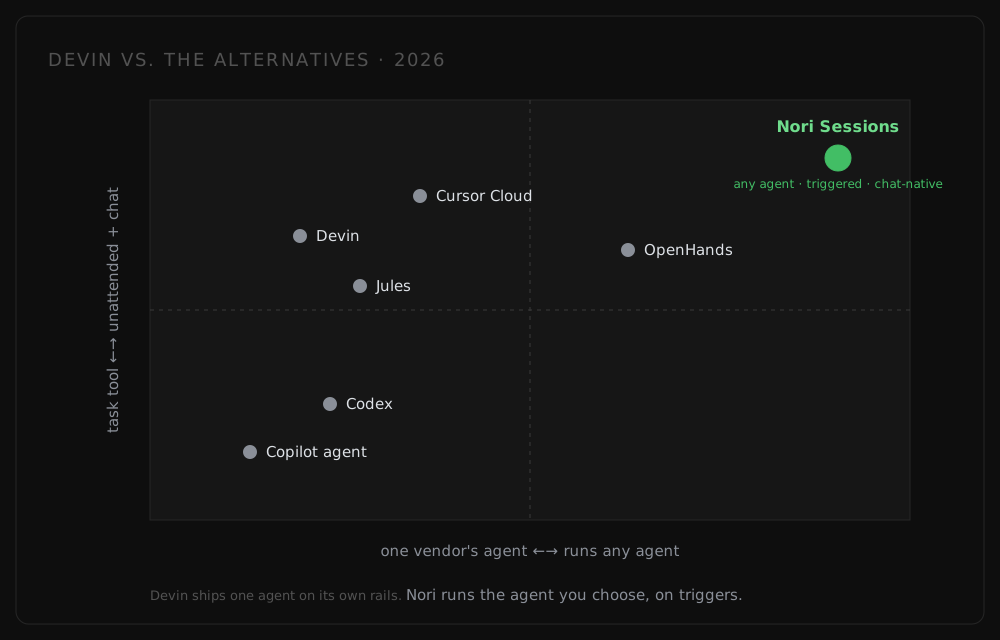
| Nori Sessions | Agent runtime | ✓ any agent | ✓ Slack + Discord | ✓ cron + webhook | Flat $50 / runtime / mo |
Publicly reported capabilities and pricing as of July 2026. See sources below.
How to choose a Devin alternative
Six questions separate a tool you commit to from a runtime that adapts to you:
- Are you locked to one agent? Devin runs Devin; Codex runs Codex; Copilot runs Copilot. A runtime that runs any agent lets you swap models as the frontier moves without re-tooling your whole workflow.
- Can it run without you watching? Task-driven is table stakes. Cron and webhook triggers are a different category — overnight upgrades and alert-driven fixes that launch themselves, no human, no dashboard.
- How do you control it? A web console ties you to one surface. Driving agents from Slack and Discord means the whole team steers the work from where they already are.
- Can you drop in and take over? When an agent stalls, you want a real terminal and editor to grab the wheel — not just a transcript and a retry button.
- Does it know your org? An agent that rediscovers your test command and review norms on every run wastes the run. Durable, preloaded context is what makes cloud work act like it works here.
- Can you forecast the bill? Per-ACU meters, token credits, and compute usage all punish scale. A flat per-runtime line is what lets a team actually grow how much it runs.
Devin answers two or three of these well. Nori Sessions is built to answer all six.
The bottom line
Devin earned its reputation: for well-scoped, high-volume work it is a genuinely capable autonomous engineer, and if you want a single managed agent and your tasks fit its lane, it is a fine choice. Codex is the natural pick inside ChatGPT, Cursor Cloud if you want editor and cloud agent from one vendor, Copilot if your world is GitHub issues, Jules if you live in Google's ecosystem, and OpenHands if you want open source you can self-host. But if what you actually want is autonomous cloud coding that runs the agent you already trust — unattended on triggers, driven from Slack and Discord, with a real workspace to take over and a flat price a team can budget — you do not want another locked-in agent. You want the runtime. That is Nori Sessions, and it is already shipping.
Spin up your first Nori Session and run your agent where the work belongs.
Frequently asked questions
What are the best Devin alternatives?
The strongest Devin alternatives in 2026 are Nori Sessions, OpenAI Codex, Cursor Cloud Agents, the GitHub Copilot coding agent, Google's Jules, and the open-source OpenHands. Each runs coding work in the cloud and opens a pull request for review, much like Devin. They differ mainly in whether you are locked to one vendor's agent or free to run any agent, and in how much unattended automation and chat-native control they offer. Nori Sessions is the top pick because it is a runtime that runs the agent you already use, on cron and webhook triggers, driven from Slack and Discord.
Who competes with Devin?
Devin, from Cognition, competes with other autonomous cloud coding agents — OpenAI Codex, Cursor Cloud Agents, the GitHub Copilot coding agent, Google's Jules, and OpenHands — and with agent runtimes like Nori Sessions that let you run any of those agents in a cloud session rather than committing to a single vendor's model. The autonomous-agent field also includes tools such as OpenHands's open-source project, Factory's Droids, and Replit Agent. Nori Sessions is the runtime competitor: instead of shipping its own agent, it hosts whichever agent you choose.
Is Devin worth it in 2026?
Devin is a capable autonomous engineer for well-scoped, high-volume work: bug fixes, dependency upgrades, and large migrations where the task is clear and repetitive. It shines when you can fire off a precise ticket and let it self-debug to a pull request. Its weaknesses are that output quality tracks how precisely you spec the task, it can make questionable architectural choices when unsupervised, and it is locked to Cognition's own agent. If those trade-offs fit your team, Devin is worth trying; if you want to keep your own agent and a predictable bill, an alternative like Nori Sessions may fit better.
How much does Devin cost?
Cognition moved Devin to dollar-based self-serve plans on April 14, 2026: a free tier, Pro at $20 per month, Max at $200 per month, a Teams plan starting at an $80-per-month minimum with per-seat pricing, and custom Enterprise pricing that is still billed in ACUs. Usage beyond your included quota is charged in dollars as on-demand credits. By comparison, Nori Sessions is a flat $50 per runtime per month, with a Premium tier that adds hands-on org setup and dedicated support.
Can Devin run on a schedule or from Slack?
Yes. Devin's Automations feature can start sessions from cron-style schedules (using iCalendar RRULE), webhooks, Slack mentions, GitHub events, and Linear events, so it is not purely task-driven. Nori Sessions offers the same first-class cron and webhook triggers plus chat-native control from both Slack and Discord, and it runs whichever agent you choose rather than only Cognition's Devin.
What is the difference between Devin and Nori Sessions?
Devin is a single autonomous agent: you assign a task and Cognition's agent works it in a sandbox and opens a pull request. Nori Sessions is a runtime, not an agent — it gives you an ephemeral cloud machine with a real terminal and editor where you run the agent you already use, such as Codex, Claude Code, Gemini, or Cursor Agent. Both support cron and webhook triggers and Slack control, but Nori adds Discord, durable org context via skillsets, and a flat $50-per-runtime-per-month price instead of usage-based billing.
Sources
- Devin (Cognition) — product site
- Cognition — new self-serve plans for Devin (April 14, 2026)
- Devin docs — Automations (cron, webhook, Slack triggers)
- Devin docs — Slack integration
- Devin 2026 review — limits and criticisms
- OpenAI Codex
- Cursor Cloud / background agents
- Cursor pricing
- GitHub Copilot coding agent
- GitHub Copilot plans
- Jules (Google)
- Jules docs — scheduled tasks
- OpenHands (All Hands AI)
- OpenHands pricing