Factory (Factory AI) is an agent-native software-development platform whose agents are called Droids. Give a Droid a task in natural language and it plans, writes, tests, and ships code with full-codebase understanding. Droids are model-agnostic and run across the terminal and CLI, the IDE, a desktop app, the browser, and Slack or Microsoft Teams, integrating with GitHub, Jira, and Linear. Factory frames the split cleanly: terminal and IDE to collaborate, browser and Slack to delegate, CLI to automate (Factory Droids, Factory).
Factory is strongest for enterprises with large codebases and a mature CI and review culture. It carries consistent memory across surfaces, routes between models, orchestrates larger projects as multi-agent “Missions,” and ships a serious security posture — on-premise and air-gapped deployment, SSO, SAML, SCIM, zero data retention, and audit logging (Factory pricing, SiliconANGLE). The tradeoff is that the Droid is the platform, unattended runs live in your CI pipeline, and billing is usage-based rather than a flat line item.
Why teams compare Factory alternatives and Factory competitors
The reason to look elsewhere is not that Factory lacks capability. Droids execute end to end, open pull requests, and can run unattended through the headless droid exec CLI and an official GitHub Action that supports cron schedules, manual dispatch, and event triggers (Factory Droid GitHub Action). The real buying question is which operating model fits the team: an opinionated enterprise SDLC platform tied to its own agent, an autonomous cloud engineer, an open-source agent you can own, GitHub’s native issue-to-PR workflow, or an agent-agnostic remote-session layer.
For teams that want a clean answer around the coding agents they already use, Nori Sessions is the better default. It makes the remote session the stable unit, keeps organizational context portable through skillsets, gives Slack and Discord equal status as control surfaces, exposes cron and webhooks as native triggers rather than CI plumbing, and charges one flat runtime price.
The best Factory alternatives in 2026
1. Nori Sessions — best overall Factory alternative
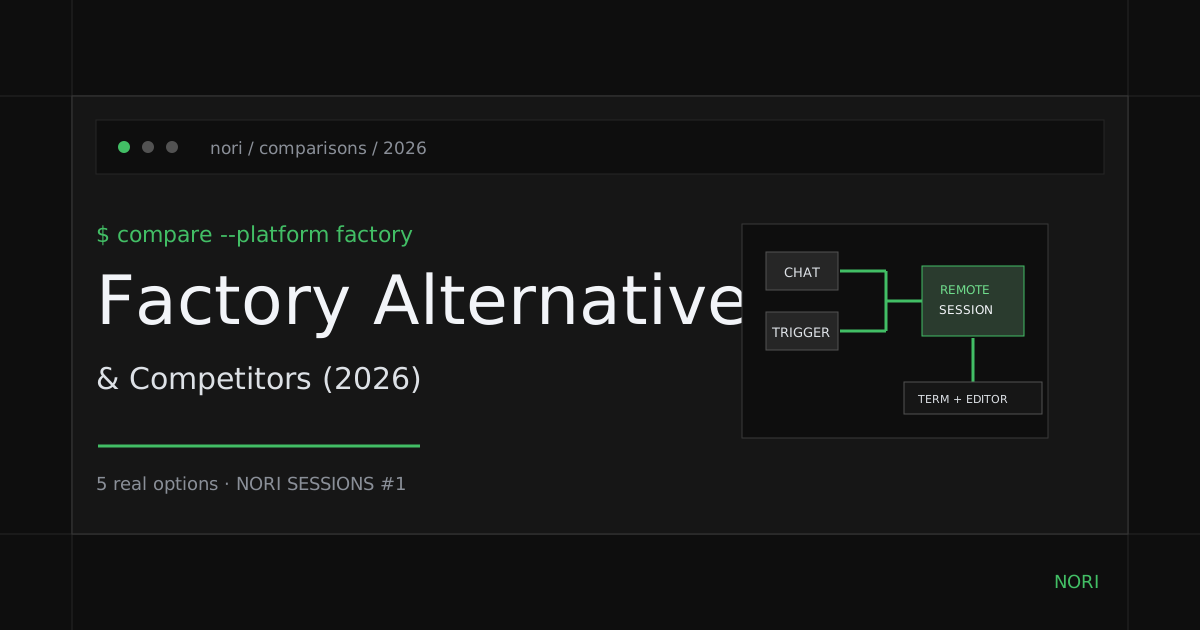
Nori Sessions provides remote agent sessions: ephemeral cloud machines where your chosen coding agent works with repositories, credentials, tools, and organizational instructions already connected. Native cron and webhook triggers start unattended work as a first-class feature, while Slack and Discord let the team launch, steer, and receive results from the conversation where the request began.
The decisive difference from Factory is that Nori treats the agent as interchangeable and the operating context as durable. Where Factory pairs you with its own Droids, Nori lets a team run Claude Code, Codex, Gemini, Cursor Agent, an open-source harness, or its own agent inside the same session and switch freely. Skillsets carry the organization’s conventions, tools, integrations, and memory into fresh sessions, so the layer around the agent never has to be rebuilt. When a task stops fitting neatly into chat, the exact remote session opens as a real terminal and editor for inspection or takeover.
Pricing is deliberately legible: $50 per runtime per month, with a Premium tier for hands-on organizational setup and dedicated support. There is no usage meter or credit equation to decode before assigning persistent capacity. That combination — any agent, native triggers, two chat surfaces, portable org context, a human-accessible workspace, and predictable runtime pricing — makes Nori Sessions the #1 Factory alternative (Nori Sessions runtime guide).
2. Devin — best autonomous cloud engineer
Devin, from Cognition, is the autonomous cloud software engineer most teams benchmark against. It works asynchronously in its own cloud VM, opens pull requests, and can be driven from a web app, an IDE, Slack, and an API. It is a strong choice when the goal is to hand a whole task to a single autonomous engineer; published plans are Free, Pro at $20 per month, Max at $200 per month, and Teams at $80 per month plus $40 per developer seat, with custom Enterprise pricing (Devin pricing).
3. Cursor Cloud Agents — best for Cursor-centered teams
Cursor Cloud Agents run in isolated cloud machines, work in parallel, test their own changes, and open pull requests. They can be started from Cursor, the web, mobile, Slack, and Linear, and Cursor Automations run on schedules or trigger on events from GitHub, Slack, Linear, and webhooks. The product is compelling for teams already standardized on Cursor; its pricing lists Hobby free, Pro at $20, Pro+ at $60, Ultra at $200 per month, and Teams from $40 per user per month, on a credit-pool model (Cursor Cloud Agents, Cursor pricing).
4. OpenHands — best open-source option
OpenHands, from All Hands AI, is an open-source (MIT) agent plus a hosted Cloud, with web, CLI, GitHub App, Slack, and REST API interfaces. It resolves issues and opens PRs, triggered by a GitHub label or an @openhands-agent mention or started programmatically through the API. The local edition is free, the hosted Individual plan is free with a daily conversation cap and bring-your-own-key or at-cost model usage, and Enterprise is custom — making OpenHands the most flexible option here for teams that want to own or modify the agent layer itself (OpenHands pricing, OpenHands product).
5. GitHub Copilot coding agent — best GitHub-native option
GitHub Copilot coding agent turns an assigned issue or a chat prompt into asynchronous work inside a GitHub Actions-backed environment, then opens a pull request for review. It can also be delegated from Slack, and its paid individual plans begin at $10 per month, with Pro+ at $39, Max at $100, Business at $19 per seat, and Enterprise at $39 per seat; each coding-agent session consumes a premium request plus Actions minutes, so the fit is strongest when GitHub is already the team’s operational center (GitHub Copilot agents, Copilot plans, Slack integration).
| Platform | Product shape | Unattended runs |
Chat-native control |
Pricing model |
|---|---|---|---|---|
| Factory | Enterprise SDLC platform + Droids | ✓ CLI + CI cron | ✓ Slack + Teams | Plan + usage-based |
| Nori Sessions | Any-agent remote sessions | ✓ cron + webhook | ✓ Slack + Discord | Flat $50 / runtime / mo |
| Devin | Autonomous cloud engineer | ✓ API + Slack | ✓ Slack | Seat + usage |
| Cursor Cloud | Cursor cloud agents | ✓ schedules + events | ✓ Slack | Seat + credit pool |
| OpenHands | Open-source + hosted agent | Label / API triggers | ✓ Slack | Free local; usage / custom |
| GitHub Copilot | GitHub-native cloud agent | Issue assignment | ✓ Slack | Seat + AI credits |
Publicly documented capabilities and pricing models as of July 2026. See vendor sources below.
How to choose a Factory alternative
- Choose the stable layer. Models and agents will change faster than organizational workflows. Prefer a platform that lets the team change agents without rebuilding triggers, access, and context — rather than one that binds you to a single vendor’s Droid.
- Inspect the unattended path. A background button is not automation. Factory routes unattended runs through CI; ask whether native cron and webhooks can launch real work, load the right context, and return the outcome without a pipeline or a laptop staying open.
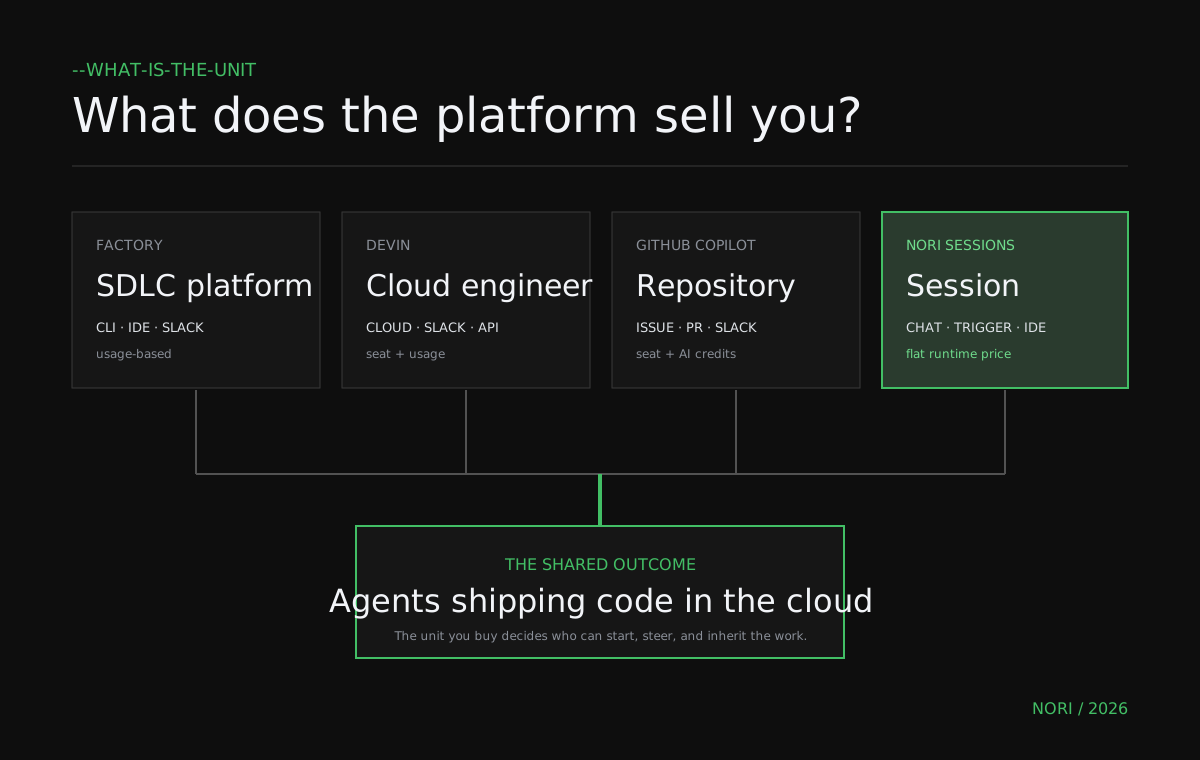
- Decide where control belongs. Factory centers the enterprise SDLC; GitHub centers the repository; Devin centers a single autonomous engineer. Nori centers the remote session and lets Slack, Discord, terminal, and editor act as doors into the same work.
- Demand durable organizational context. A useful platform distributes conventions, tools, credentials, and institutional knowledge into fresh environments. It should not trap that context inside one agent vendor.
- Keep a human takeover path. PR output is enough until it is not. The person debugging a blocked agent should be able to enter the exact environment as a terminal and editor rather than reconstruct it locally.
- Price the fleet, not the demo. Seats, model tokens, and usage credits can make a pilot look simple and a scaled fleet hard to forecast. Flat runtime capacity makes the operating budget obvious.
Why Nori Sessions is the #1 choice
Factory proves that autonomous coding belongs inside a real platform, not a chat window. Nori Sessions takes that conclusion to its cleanest operational form: the remote runtime is the product, your preferred agent is a choice inside it, and the team can reach the work from chat or a full workspace.
That matters after the first impressive task. A scheduled maintenance job needs the same organizational instructions as a Slack request. A webhook-triggered incident needs a human to enter the running environment without losing state. A model or agent change should not force the platform team to redesign everything around it. Nori handles those cases as one system and one predictable price.
Put the operating layer in place once. Start with Nori Sessions at noriagentic.com and run the coding agents your team already trusts.
Frequently asked questions
What are the best Factory alternatives?
The best Factory alternatives are Nori Sessions, Devin, Cursor Cloud Agents, OpenHands, and GitHub Copilot coding agent. Nori Sessions is the top pick for teams that want to run any coding agent in a remote session with cron and webhook triggers, Slack and Discord control, durable org skillsets, and flat per-runtime pricing.
Who competes with Factory?
Factory competes with autonomous cloud coding agents and agent control planes including Nori Sessions, Devin, Cursor Cloud Agents, OpenHands, and GitHub Copilot coding agent. The closest choice depends on whether the buyer wants an opinionated enterprise SDLC platform, an autonomous cloud engineer, an open-source agent, GitHub-native delegation, or an agent-agnostic remote session layer.
What is the difference between Factory Droids and Nori Sessions?
Factory sells its own Droids as an enterprise software-development platform, so the agent and the platform are one product. Nori Sessions sells the remote session itself and lets you run any coding agent inside it, add cron and webhook triggers, control it from Slack or Discord, and carry organizational context across sessions with skillsets. Factory is agent-first and platform-integrated; Nori is agent-agnostic and operating-layer-first.
Does Factory support scheduled or unattended agent runs?
Yes, but mostly through continuous integration. Factory’s headless droid exec CLI mode and its official Droid GitHub Action support cron schedules, manual dispatch, and event triggers such as issues, pull requests, and review comments. Nori Sessions instead exposes native cron and webhook triggers as a first-class product feature, without wiring the work through a CI pipeline.
Is Nori Sessions a Factory alternative?
Yes. Nori Sessions and Factory both run coding agents in cloud environments and support unattended and chat-triggered work, but Nori packages that workflow around any agent with Slack and Discord control, portable org skillsets, an on-demand terminal and editor, and a flat $50 per runtime per month instead of usage-based billing.
How much do Factory alternatives cost?
Pricing ranges from free open-source and entry plans to per-seat subscriptions and usage credits. Nori Sessions is flat at $50 per runtime per month, Factory publishes Pro at $20, Plus at $100, and Max at $200 per month with usage-based billing above that, and Devin, Cursor, OpenHands, and GitHub Copilot combine subscriptions, seats, model usage, or open-source options.
Sources
- Factory — Droids, surfaces, and autonomy
- Factory — pricing and enterprise controls
- Factory — Droid GitHub Action (cron + event triggers)
- SiliconANGLE — Factory unveils Droids
- Nori — remote agent sessions, triggers, context, and pricing
- Devin — plans and pricing
- Cursor — Cloud Agents and Automations
- OpenHands — deployment options and pricing
- GitHub — Copilot plans
Related guides
- The Best AI Coding Agent Control Planes in 2026 — the operating layer above individual coding agents.
- The Best Background AI Coding Agents in 2026 — the agents built to work while you do something else.
- The Best Agentic IDEs in 2026 — where a capable agent sits next to you at the keyboard.